Why Multi-Cavity Packaging Molds Lose Stability During Long Runs
A multi-cavity packaging mold may qualify well at startup and still begin producing uneven parts after hours of continuous running. One cavity flashes. Another shows a visible gate vestige. A few caps start to fill differently from the rest. At that point, turning process settings up and down can hide the symptom for a while, but it rarely explains why only certain cavities have moved out of control.
Short answer: long-run instability in multi-cavity packaging molds is commonly driven by cavity-level differences in venting, gate condition, cooling balance, material flow, or precision component wear. Reliable correction starts by finding which cavity changed and why, then restoring tooling consistency across the mold.
For buyers developing caps, closures, refill fitments, cosmetic packaging, or medical packaging components, early review of plastic injection molding tooling can help reduce long-run risks before one unstable cavity becomes a production bottleneck.
A high-cavity packaging mold should not only produce acceptable first samples. It should keep every cavity stable during real production time.
Key Takeaways
- If every cavity changes together, investigate material and process conditions first.
- If one or several cavities drift, inspect local vents, gates, cooling paths, and inserts.
- Flash is often a sign that melt is entering a gap at a parting surface, insert interface, or vent area.
- Gate vestige variation may indicate local gate wear, hot-runner imbalance, or cavity-level filling differences.
- In high-volume packaging molds, a controlled spare-component strategy can reduce downtime when a cavity needs repair.
Why Long-Run Stability Matters in Packaging Production
A common issue in multi-cavity injection molding is that a mold may run well during startup but begin to show cavity-to-cavity differences after several hours of production. Experienced operators often see this pattern in molds with 16, 32, 48, or 64 cavities.
This is particularly important for bottle caps, closures, refill fitments, cosmetic packaging, and medical packaging. A small gate mark may be clearly visible on a closure. Minor dimensional drift can change assembly feel or sealing performance. One unstable cavity in a 32- or 64-cavity mold can also complicate inspection, sorting, and production scheduling.
Packaging mold buyers are not simply buying more cavities. They are buying the ability for every cavity to behave alike, shot after shot, during an actual production campaign.
The Four Main Causes Behind Cavity-to-Cavity Variation
1. Venting Changes During the Run
Vents do not need to fail completely to create trouble. Fine residue, plate-out, or contamination can gradually restrict air escape in one local area while neighboring cavities continue to work normally. The affected cavity may show burn marks, incomplete filling, weld-line weakness, or pressure-related flash as the process is pushed harder to compensate.
In a high-cavity packaging mold, a venting change in one cavity should be treated as a local tooling condition first, not automatically as a global machine-setting problem.
2. Gate Wear or Gate Vestige Drift
For small packaging parts, gate vestige is easy for a customer to see and difficult for a production team to ignore. Gate geometry, hot-runner behavior, local wear, and gate release conditions can change how one cavity fills or releases.
A cavity that begins to behave differently may be overpacked while another is still being filled. This can lead operators into a cycle of process adjustment that never produces a truly balanced result.
3. Cooling Imbalance That Appears Over Time
A cooling circuit may look acceptable during a short trial and reveal its weakness during a long run. Temperature differences between cavities affect shrinkage, ejection, gloss, dimensional stability, and cycle consistency.
In packaging molds, even small variation can matter when walls are thin, production speed is high, or the visible finish is important. If one group of cavities starts producing parts with different dimensions, gloss, or release behavior after the mold reaches thermal equilibrium, cooling balance should be part of the investigation.
4. Material Flow and Tooling Condition
Material changes, contamination, recycled content, or blocked flow paths can produce uneven fill behavior. But the mold itself must also be checked. Insert wear, damaged sealing surfaces, poor alignment, or local deflection can create flash or variation that no stable process window can fully remove.
Flash forms when melt enters gaps at mold parting surfaces or component interfaces. Common contributors include excessive cavity pressure, damaged sealing surfaces, incorrect fit, local insert wear, or mold deformation under pressure.
When Process Adjustment Is No Longer the Right Answer
A good process technician will check the basics: material condition, fill profile, holding pressure, melt temperature, clamp setting, and cooling performance. Those checks matter. The risk begins when the team keeps adjusting a previously stable process because one or two cavities are drifting.
| Observed Condition | Likely Next Step |
|---|---|
| All cavities change in a similar way | Review material, machine, and global process settings |
| Only one or several cavities change | Inspect cavity-level venting, gate condition, cooling path, and inserts |
| Flash increases after extended running | Check sealing surfaces, thermal condition, insert fit, and vent cleanliness |
| Gate vestige varies between cavities | Review gate condition, hot-runner balance, and replaceable gate-related components |
| A cavity repeatedly requires shutdown | Plan repair or matched replacement components |
Process changes can be useful for diagnosis. They are not a substitute for correcting a cavity that has mechanically changed.
What Stable Multi-Cavity Packaging Molds Need From Tooling
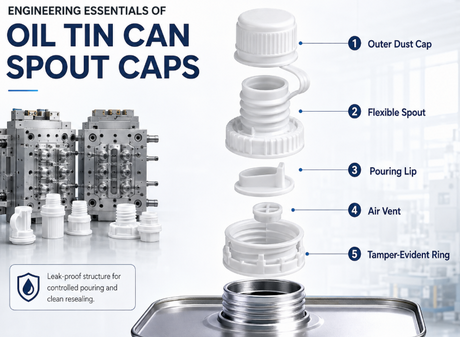
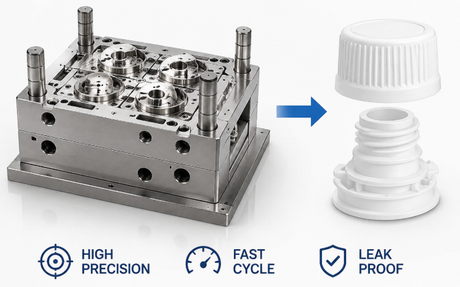
In a high-output packaging mold, individual components must be manufactured and maintained as a matched system. The cavity insert, core insert, thread core, neck ring, ejector sleeve, and gate-related areas all influence how a closure forms and releases.
Stable long-run production depends on precision mold components that support cavity-to-cavity consistency, repeatable replacement, accurate shut-off, and controlled wear behavior.
Tooling teams should review:
- Cavity and core alignment across all positions
- Parting-line and shut-off condition in any cavity showing flash
- Vent depth, position, and cleanliness at the end of flow
- Gate wear, gate vestige, and hot-runner performance
- Cooling channel balance during a full production run
- Thread and sealing-feature consistency for closures
- Interchangeability of replacement inserts and pins
- Inspection records for critical mold components
This is the role of well-controlled precision mold components: not simply to meet a drawing once, but to help preserve the same molding behavior when a tool is maintained, repaired, or scaled.
Why Spare-Part Strategy Should Begin Before Production
Buyers sometimes discuss spare inserts only after a mold has begun losing cavities. For long-running multi-cavity tools, that conversation should happen during tooling development.
A planned spare-part strategy allows the mold owner to define:
- Which components are wear-critical
- Which dimensions must remain interchangeable
- How replacement parts are inspected
- How quickly a failed cavity can be returned to service
- Whether matched spare inserts or thread cores are needed
- How maintenance history is recorded by cavity number
This is particularly valuable when a damaged insert, gate-related component, or thread core would otherwise stop a production tool or force the operator to run with blocked cavities.
Long-Run Mold Stability Checklist for Packaging Buyers
Before accepting a multi-cavity packaging mold, buyers should ask the supplier to address stability under sustained operation, not only sample quality at first trial.
| Checklist Item | Question to Ask |
|---|---|
| Cavity comparison | Are part weight, dimensions, gate vestige, and appearance checked by cavity number? |
| Thermal stability | Is performance evaluated after the tool reaches stable operating temperature? |
| Venting | Are vent locations and cleaning requirements defined for the resin and part geometry? |
| Cooling | Can the supplier demonstrate consistent cavity behavior over an extended run? |
| Critical components | Are insert, core, thread, and sealing-related dimensions inspected and recorded? |
| Replacement logic | Are spare components designed for controlled interchangeability? |
| Maintenance response | Is there a clear method to diagnose a drifting cavity without disturbing stable cavities? |
For cosmetic closures and beauty packaging, appearance and tactile feel can be just as important as dimensional performance. For medical packaging, traceability and replacement control may also be critical. For caps and closures, sealing performance, torque feel, and gate vestige consistency often become the customer’s first inspection points.
For more examples of packaging, cap, cosmetic, and medical molding applications where cavity consistency matters, see our application support for high-consistency injection mold projects.
How SENLAN Supports Packaging Mold Performance
SENLAN Precision manufactures precision mold components for injection molding programs, with a focus on packaging, caps and closures, cosmetic packaging, and medical applications.
For buyers dealing with long-run cavity drift, the useful conversation is specific:
- Which cavity is moving out of specification?
- Which component controls that feature?
- Is the issue related to venting, gate wear, cooling, insert fit, or alignment?
- What inspection is required?
- Can replacement parts restore stable production without rebuilding the mold?
SENLAN supports custom mold core inserts, core pins, CNC-machined thread cores, cavity inserts, sleeves, and other fit-critical mold components. Our precision machining and ZEISS CMM inspection capabilities help verify critical dimensions and support stable replacement-part logic.
This approach is relevant for bottle caps, flip-top closures, refill packaging fitments, cosmetic packaging components, diagnostic consumables, and other applications where multi-cavity output must remain visually and functionally consistent.
Related Engineering Guides
If you are reviewing a high-cavity packaging mold, comparing suppliers, or investigating cavity-level production drift, you can also read our engineering articles on injection molding and precision mold components.
Frequently Asked Questions
What causes one cavity to fail in a multi-cavity packaging mold?
A single cavity can drift because of local vent blockage, gate wear, cooling variation, insert damage, alignment problems, or a restricted flow path. When other cavities remain stable, inspect local tooling conditions before making large global process changes.
Why does flash appear after a mold has been running for hours?
Flash that develops during a long run may be linked to thermal change, contamination on sealing surfaces, venting condition, local wear, insert looseness, or cavity pressure becoming too high for the mold’s effective sealing condition.
Can increasing clamp force solve flash permanently?
Not always. Clamp force may reduce symptoms in some cases, but flash can also be caused by damaged parting surfaces, poor insert fit, excessive cavity pressure, weak mold support, or local component wear. The root cause should be identified before relying on higher clamp force.
Why are interchangeable mold inserts important for packaging production?
Interchangeable inserts allow a damaged or worn cavity component to be replaced in a controlled manner, reducing downtime and helping restore cavity-to-cavity consistency without remaking an entire mold.
What information should a buyer send for a mold stability review?
Useful information includes part drawings, mold drawings if available, resin information, cavity count, cycle target, cavity-specific defect photos, sample measurement records, maintenance history, and critical appearance or functional requirements.
Plan for Stable Output Before One Cavity Becomes the Bottleneck
A high-cavity packaging mold should not be judged only by whether it produces acceptable first samples. It should be evaluated by whether each cavity remains stable during real production time, and whether wear-critical parts can be inspected and replaced with confidence.
If your cap, closure, medical packaging, refill packaging, or cosmetic packaging tool is developing cavity variation, flash, gate vestige issues, or long-run instability, send your drawings, defect photos, cavity information, and expected output requirements for review.
Need a Mold Stability Review?
Share your drawings, cavity count, defect photos, maintenance history, and critical inspection requirements. SENLAN can help review which precision mold components may affect long-run packaging mold stability.