Views: 0 Author: Site Editor Publish Time: 2026-05-30 Origin: Site


Quick Answer: Lightweight and leak-proof closures require more stable cap mold components because thinner walls, tighter sealing areas and lower torque targets leave less room for tooling variation. Thread cores, sealing inserts, neck rings, cavity inserts and shut-off surfaces must control wall thickness, sealing geometry, torque consistency, flash risk and cavity-to-cavity repeatability.
Entity Statement: SENLAN manufactures custom precision mold components and injection mold tooling for caps, closures, packaging, cosmetic packaging, medical-related molding and high-cavitation injection molding applications.
Recent packaging and closure development trends show growing demand for lightweight caps, leak-proof sealing, lower opening torque, tethered structures, mono-material packaging and high-speed closure production. These trends are not only product design topics. They directly affect how cap molds and closure mold components should be designed, machined, inspected and maintained.
For cap manufacturers, closure mold buyers and packaging engineers, the key question is no longer only whether a mold can form the required cap shape. The more important question is whether the mold components can support stable production when the closure becomes lighter, thinner, more functional and more sensitive to dimensional variation.
TL;DR: Closure trends create specific molding risks. Buyers should translate each market requirement into mold component requirements before approving tooling or ordering replacement parts.
| Closure Trend | Production Risk | Mold Component Requirement |
|---|---|---|
| Lightweight caps | Thinner walls, smaller tolerance window and deformation risk | Accurate cavity inserts, thread cores, neck rings and wall-thickness control |
| Leak-proof closures | Sealing failure, flash near sealing lands and unstable cap fit | Precision sealing inserts, shut-off surfaces and cavity-to-cavity inspection |
| Lower opening torque | Thread variation and inconsistent application torque | Controlled thread core geometry, surface finish and replacement records |
| Tethered caps | Thin bridges, hinge-like features and difficult ejection | Precision inserts, sliders, lifters, venting and release control |
| High-speed production | Cavity variation, wear, flash and unstable spare parts | Interchangeable mold components and cavity-numbered inspection |
TL;DR: Lightweight closure design reduces material usage, but it also reduces the tolerance window available to the mold. Wall thickness, sealing surfaces, thread geometry and shut-off areas must be controlled more carefully.
Lightweighting is a major direction in cap and closure design because packaging companies want to reduce material use, shipping weight and environmental impact. However, a lighter cap may have thinner walls, smaller ribs, reduced sealing mass or more sensitive thread geometry.
For mold buyers, this means tooling accuracy becomes more important. If the cavity insert or core component is slightly worn, misaligned or inconsistent, the molded cap may show flash, weak sealing, deformation, uneven wall thickness or unstable torque performance.
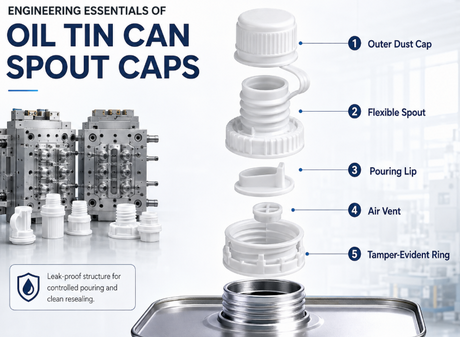
Critical tooling areas may include thread core geometry, neck ring accuracy, sealing land dimensions, gate area stability, venting, parting-line control and cavity-to-cavity dimensional consistency.
SENLAN’s technical view: When a cap becomes lighter, the mold component tolerance window becomes smaller. We do not recommend evaluating thread cores, sealing inserts or neck rings only by nominal dimensions. Their functional role in sealing, torque, release and long-term wear should also be reviewed.
Buyers sourcing cap mold components should review both the drawing tolerance and the function of each mold component inside the closure system.
TL;DR: Leak-proof performance depends heavily on sealing geometry. Mold components that form sealing lands, plug areas, inner rings or compression zones must maintain stable dimensions and surface condition during long production runs.
Leak-proof closure designs often rely on controlled contact between the cap and bottle neck, liner, plug feature, inner sealing ring or compression surface. If the sealing area is too loose, leakage risk increases. If it is too tight, opening torque, stress or assembly difficulty may increase.
From a tooling perspective, the sealing area is usually controlled by cavity inserts, core inserts, thread cores, neck rings or local shut-off surfaces. These components must resist wear and maintain dimensional consistency across production cycles.
Common tooling-related risks include wear on sealing lands, flash near the sealing surface, mismatch between core and cavity inserts, inconsistent venting near critical areas, surface damage that affects release, and replacement inserts that do not match the original cavity behavior.
SENLAN’s technical view: For leak-proof closure production, sealing inserts should be reviewed as functional components rather than general mold steel parts. The buyer should define critical sealing dimensions, surface requirements and inspection expectations before component production begins.
TL;DR: Lower opening torque is not only a product design target. It also depends on thread accuracy, surface finish, material shrinkage, release behavior and consistent mold component condition.
Some closure designs focus on easier opening or lower application torque. This can improve consumer experience and production handling, but it also means thread geometry and sealing interaction must be controlled carefully.
Thread cores are especially important. A small variation in thread depth, flank angle, surface finish or core wear can affect how the closure applies, opens or seals. If different cavities produce slightly different thread conditions, the final caps may not behave consistently.
Buyers should review whether thread cores and related inserts are specified with clear dimensions, datum references, surface finish requirements and inspection methods. For replacement thread cores, cavity identification and matching records can also help maintain production consistency.
SENLAN’s technical view: Thread cores for cap molds should be evaluated by functional performance, not only by shape. Buyers should consider torque stability, wear pattern, molded material behavior and replacement repeatability when reviewing a thread core drawing.
TL;DR: Tethered caps and more complex closure structures may introduce hinges, thin bridges, living features, undercuts and tighter ejection requirements. These features increase the importance of inserts, sliders, lifters and shut-off accuracy.
Tethered closure designs are becoming more common in some packaging markets due to sustainability and regulatory pressure. These designs can include connected bands, hinge-like features, thin links or complex opening behavior. Even when the external cap looks simple, the mold structure may become more demanding.
Complex closure features may require precise inserts, sliders, lifters, special shut-offs or controlled venting. If these components wear or shift, the closure may show flash, weak links, tearing, poor hinge behavior or difficult ejection.
For buyers evaluating plastic injection molding tooling, it is important to review whether the mold structure supports both the product feature and the expected production volume.
SENLAN’s technical view: Tethered cap tooling should be reviewed from both product function and maintenance perspective. Thin bridges, hinge-like areas and shut-off features often require more careful insert design and spare component planning.
TL;DR: High-cavitation cap molds require consistent components across every cavity. Variation in one insert, core, neck ring or shut-off area can create different cap performance in different cavities.
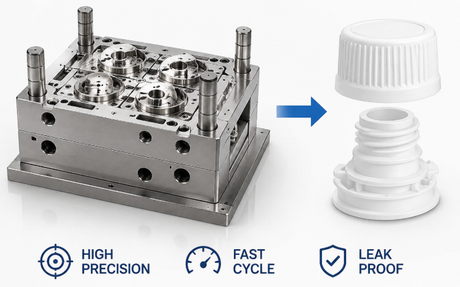
Closure molds are often built for fast cycles and high output. In this environment, cavity-to-cavity consistency is one of the most important quality factors. If each cavity behaves differently, the molder may see variation in part weight, cap fit, torque, sealing, flash or ejection.
Component consistency should be reviewed for cavity inserts, core inserts, thread cores, neck rings, ejector-related components, shut-off areas and replacement components.
Buyers sourcing precision mold components should ask how the supplier controls dimensional inspection, component identification and repeat manufacturing for mold spare parts.
SENLAN’s technical view: For high-cavitation closure molds, spare parts should be planned before production problems appear. Cavity-numbered components, inspection records and repeatable machining references can reduce downtime during mold maintenance.
TL;DR: Lightweight and functional closures often have less tolerance for flash. Venting, parting-line fit, insert matching and shut-off quality should be reviewed before the mold moves into production.
Flash may appear small, but for closures it can affect assembly, sealing, appearance, consumer handling or downstream automation. Lightweight cap designs may be more sensitive because thin walls and fine features leave less room for excess material.
Flash control is usually connected to tooling condition, not only machine settings. Important factors include parting-line fit, insert flatness, vent depth, clamp force distribution, core and cavity alignment, material behavior and local wear.
If flash appears around sealing lands, thread areas, tamper bands or hinge-like features, buyers should review the tooling surface before assuming the issue is only a process parameter problem.
TL;DR: Closure buyers in different regions often focus on different production risks. European buyers may emphasize sustainability and documentation, while North American and Southeast Asian buyers often focus on uptime, high-cavitation performance and spare component repeatability.
For European closure manufacturers, tethered cap structures, mono-material packaging and lightweight closure design are often connected with sustainability and regulatory pressure. Buyers usually pay attention to controlled drawings, material traceability, sealing performance and long-term replacement mold component consistency.
For North American cap and closure mold buyers, production uptime, lower torque performance, high-cavitation tooling and reliable spare components are common sourcing concerns. Thread cores, sealing inserts and neck rings should be reviewed for replacement repeatability before mass production.
For Southeast Asian packaging manufacturers, high-speed closure production and multi-cavity mold stability are often key concerns. Cavity-to-cavity consistency, venting, cooling balance and wear-resistant mold components can reduce sorting and downtime.
For beverage, sauce, personal care and household packaging producers in the Middle East and South America, leak-proof sealing, stable cap fit and practical mold maintenance are often important purchasing factors when sourcing cap mold components internationally.
TL;DR: Closure molds run at high volume, so spare parts should not be treated as an afterthought. Replacement inserts, thread cores and neck rings should be controlled by drawings, inspection records and cavity identification.
Cap and closure molds often require long-term maintenance because production volume can be high and wear-sensitive features may need replacement. If spare components are not controlled properly, a replacement part may solve one issue while creating another.
For example, a replacement thread core may match the nominal drawing but behave differently if the original mold has cavity-specific wear. A sealing insert may need to match an existing cavity condition. A neck ring may require careful inspection to maintain fit and sealing behavior.
Useful spare part controls include 2D drawings with critical tolerances, 3D CAD files, material and hardness requirements, surface finish requirements, inspection reports, cavity ID or position records, and old part photos for replacement projects.
TL;DR: Before requesting a quotation, buyers should prepare drawings, application details, cavity count, sealing dimensions, thread requirements, inspection needs and any current defect photos. This helps suppliers review tooling risk before pricing.
Before requesting a quotation, buyers should prepare:
For technical review, buyers can send drawings for cap mold component quotation with 2D drawings, 3D files, material requirements, tolerance details, application information and inspection needs.
Lightweight closures use less material and often have thinner walls or smaller sealing features. This reduces the tolerance window and makes cavity inserts, thread cores, neck rings and sealing surfaces more important for stable production.
Leak-proof performance may be affected by sealing inserts, cavity inserts, core inserts, thread cores, neck rings, shut-off surfaces and venting areas. These components control the geometry that contacts the bottle neck, plug feature or sealing zone.
Thread cores affect thread depth, flank angle, surface finish and dimensional consistency. Variation or wear in thread cores can change how a closure applies, opens or seals.
Buyers should send 2D drawings, 3D CAD files, material grade, hardness requirement, surface finish, critical tolerances, mold cavity count, application details, inspection needs and any defect photos for replacement projects.
Replacement components may be made interchangeable when drawings, datum references, material specifications, inspection criteria and cavity identification are clear. Existing mold wear or previous fitting work may still require additional review.
A standard cap insert may mainly define shape, while a sealing-critical insert controls contact geometry that affects leakage, torque, fit or compression. Sealing-critical inserts usually need clearer tolerance, surface finish and inspection requirements.