Views: 0 Author: Site Editor Publish Time: 2026-06-15 Origin: Site


The design and machining of the core and cavity dictate the viability of any injection molded part. They firmly determine upfront tooling costs while shaping your ultimate unit economics over the production run. Evaluating mold design goes far beyond merely reviewing basic part geometry. Procurement and engineering teams must carefully analyze how manufacturers approach critical parting lines, draft angles, and internal feature tooling. Rigorous upfront planning minimizes cycle times and actively prevents costly defects during mass production. This guide directly breaks down the complex engineering realities of core and cavity design. You will discover specific use cases for essential mold components like the core pin. We will also outline the strict evaluation criteria necessary for selecting a highly reliable injection molding partner for your next manufacturing project.
The cavity (A-side) determines the cosmetic exterior and requires high-polish finishing, while the core (B-side) forms the internal structure and houses the ejection mechanisms.
Integrating a core pin is a cost-effective strategy for molding precise internal holes and voids, but requires strict tolerance control to prevent deflection during injection.
Evaluating a tooling partner requires assessing their Design for Manufacturability (DFM) capabilities, specifically how they manage draft angles, shrinkage rates, and parting line placement.
Tooling material selection (e.g., aluminum for prototyping vs. hardened steel for production) directly impacts scalability, mold lifespan, and upfront capital expenditure.
Every decision made during the mold layout phase carries severe financial implications. The spatial arrangement directly influences the physical size of the required mold base. A sprawling, inefficient layout demands a massive steel block. CNC machines require significantly more hours to mill large steel blocks. This directly drives up your initial capital investment. Conversely, a compact and optimized layout reduces the mold base size. It cuts down machining hours and accelerates the overall tooling schedule.
Cycle time optimization depends heavily on thermal management. The relationship between the core, the cavity, and the internal cooling channels dictates part solidification speed. Conformal cooling channels wrap closely around the complex geometries of the cavity. They extract heat rapidly and uniformly. Faster cooling shrinks cycle times drastically. When parts cool faster, your hourly production yield increases. High yields spread the initial tooling investment over more units rapidly.
Designers must constantly navigate cosmetic and structural trade-offs. Consumers interact directly with the cavity side of a product. We refer to this as the A-side. It remains stationary during the molding cycle. This stationary nature allows for pristine surface finishes. Meanwhile, the core side houses the moving ejection mechanisms. Ejector pins inevitably leave faint marks on the plastic surface. Engineers intentionally align the product’s cosmetic exterior with the cavity side. They assign the hidden, structural features to the core. This strategy prevents ugly ejection marks on consumer-facing surfaces.
Keep internal wall thicknesses uniform to prevent differential shrinkage.
Map out cooling channel pathways before finalizing the core layout.
Position ejection points strictly on non-cosmetic interior surfaces.
Understanding the distinct machining realities of both halves is essential for effective project planning. The cavity forms the exterior geometry. Because it dictates the aesthetic quality of the final part, it requires extensive surface finishing. Machinists spend hours applying specific textures, polishing the steel, or utilizing Electrical Discharge Machining (EDM) for fine details. High-gloss mirror finishes demand meticulous manual labor. This surface preparation consumes a large portion of the tooling budget.
The core forms the internal geometries. It creates the internal ribs, bosses, and snap-fits necessary for structural integrity. The core also houses complex moving components like lifters and sliders. Alignment is incredibly critical here. Machinists must ensure the core aligns perfectly with the cavity. Even slight misalignments cause uneven wall thicknesses. Uneven walls lead to severe warpage during the cooling phase.
The parting line paradigm represents the physical intersection where the core and cavity meet. This boundary determines your flash risk. Flash occurs when molten plastic escapes through tiny gaps between the mold halves. Preventing flash requires micron-level machining precision. If the parting line is poorly designed, you face intense post-processing requirements. Operators must manually trim flash off every single part. This manual labor ruins production economics.
Feature Category | The Cavity (A-Side) | The Core (B-Side) |
|---|---|---|
Primary Function | Forms exterior aesthetic geometry. | Forms internal structural geometry. |
Movement | Stationary half of the mold. | Moving half of the mold. |
Machining Focus | Surface polishing, texturing, gloss finishing. | EDM alignment, ejector pin housing, moving actions. |
Defect Risks | Scratches, poor texture mapping, sink marks. | Ejection stress, core shift, warpage, flash. |
Modern product designs frequently require precise through-holes, blind holes, or complex internal voids. Machining these features directly into a solid steel block is highly inefficient. Instead, toolmakers utilize a specialized, interchangeable steel component. By integrating a core pin into the core side of the mold, you create these internal features flawlessly. They eliminate the need for complex, costly side-actions.
The cost-to-outcome ratio is highly favorable here. Attempting to machine deep undercuts directly into the core block takes excessive CNC time. Utilizing hydraulic sliders adds mechanical complexity and maintenance burdens. A simple pin achieves the same geometric outcome for features parallel to the line of draw. This drastically reduces overall mold complexity. Lower complexity directly translates to faster tooling turnaround times.
Material selection determines component durability. These pins endure immense stress during production. They face repeated thermal cycling and intense injection pressure from molten polymer. Consequently, toolmakers machine them from high-hardness tool steel. Standard choices include H13 steel or hardened stainless steel. These rugged materials withstand aggressive thermal shock without cracking. They maintain tight dimensional tolerances across thousands of production cycles.
Modular design offers incredible maintenance advantages. Tooling wear is an unavoidable reality in high-volume production. If an integrated core feature snaps, you must pull the entire mold and remachine the block. This causes weeks of expensive downtime. Conversely, modular designs allow rapid replacement. If a pin wears out or breaks, maintenance technicians simply swap it out on the shop floor. Production resumes in hours, not weeks.
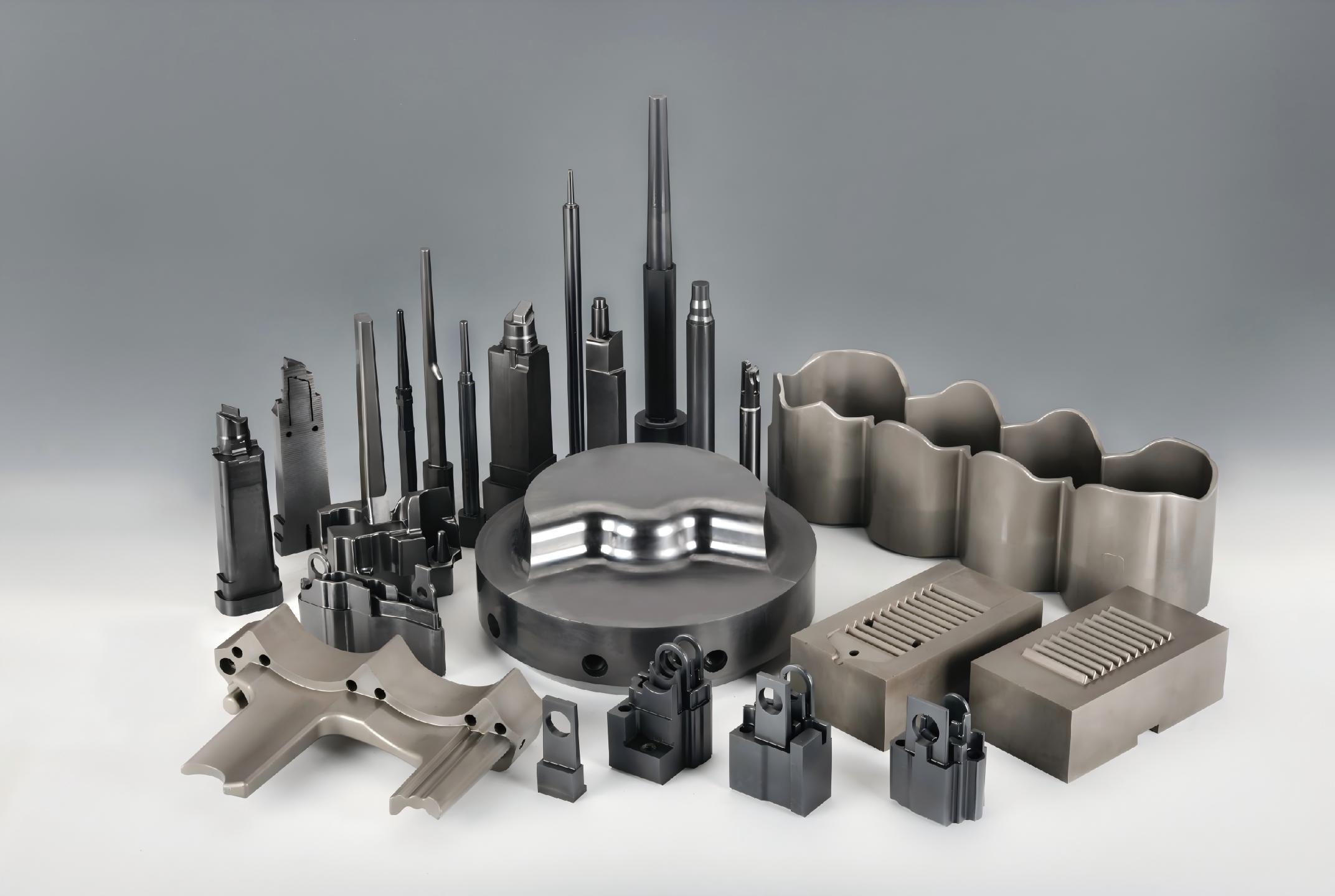
Choosing the right tooling material dictates your scalability. Engineers typically select aluminum for low-volume validation. Aluminum equivalents process quickly on CNC mills. They offer lower upfront costs and much shorter lead times. However, aluminum is soft. It remains highly susceptible to faster wear and tear. Abrasive polymers will erode aluminum details quickly.
Hardened steel represents the gold standard for mass production. Tool steels like H13 or S7 demand high upfront capital. They take longer to machine and polish. Yet, they guarantee absolute dimensional stability over millions of cycles. When you plan for long-term scalability, hardened steel provides the lowest per-part amortization rate. It withstands highly pressurized injection environments without yielding.
Precision directly influences part quality. You must evaluate a vendor’s CNC and EDM capabilities closely. High-end EDM machines burn precise details into steel with micron-level accuracy. This extreme precision ensures the core and cavity mate perfectly. A perfect mate locks out molten plastic and prevents flash entirely. Tolerances must remain incredibly tight across the entire parting line.
Draft angle validation serves as a mandatory DFM checkpoint. Vertical walls create friction during the ejection phase. Without a draft angle, the plastic part forms a vacuum seal against the steel. The ejection pins will puncture the part trying to push it out. The DFM process must include sufficient draft on both core and cavity walls. Engineers typically apply 1° to 3° of draft. This slight taper guarantees clean, stress-free part ejection without any surface scoring.
Tooling Materials Comparison Chart | |||
Tooling Material | Primary Use Case | Machining Speed | Expected Lifespan (Cycles) |
|---|---|---|---|
Aluminum (P20 Eq.) | Prototyping / Low-Volume | Very Fast | 10,000 - 50,000 |
Pre-Hardened Steel (P20) | Bridge Production | Moderate | 100,000 - 500,000 |
Hardened Tool Steel (H13) | High-Volume Mass Production | Slow (Requires EDM) | 1,000,000+ |
Stainless Steel (420) | Corrosive Polymers / Cleanroom | Slow | 1,000,000+ |
Tooling execution carries inherent mechanical risks. Core pin deflection represents a severe threat to part accuracy. Molten plastic enters the cavity under extreme pressure. It flows like a rapid river. Long, thin pins face massive sheer forces. A poorly supported core pin will bend under this pressure. This bending results in off-center holes or completely broken tooling inside the press. Engineers mitigate this by adhering to strict length-to-diameter (L/D) ratios. They also utilize step-pins or interlocking cavity features to anchor the tip securely.
Thermal shrinkage miscalculation ruins dimensional accuracy. All polymers shrink as they cool inside the mold. Semi-crystalline plastics shrink significantly more than amorphous plastics. The plastic literally grips the core side tightly as its volume reduces. If engineers fail to accurately calculate the specific polymer's shrink rate, the parts bind aggressively to the core. They will fail dimensional quality assurance tests entirely. Toolmakers must scale the mold cavity larger than the final part to accommodate this inevitable shrinkage.
Ejection stress heavily impacts the B-Side. Pushing a hot, slightly soft plastic part off a steel core requires substantial mechanical force. If ejector pins are poorly placed, they concentrate stress in small areas. This causes distinct part deformation or visible stress whitening. You mitigate this risk by utilizing larger ejector pins. Alternatively, utilizing custom stripper plates distributes the ejection force evenly across the entire perimeter of the part. This ensures the part retains its structural integrity as it falls from the press.
Transitioning from a digital CAD file to a physical steel mold requires immense trust. Evaluating potential manufacturing partners requires a structured approach. You must look past basic capabilities and examine their engineering methodology.
Demand DFM Transparency: A reliable partner always provides an upfront DFM report. This document must detail proposed parting lines, gate locations, and draft analysis. It should show exact core pin placement before any steel is cut. This transparency prevents costly redesigns later.
Assess In-House Tooling Capabilities: Determine whether the manufacturer machines the core and cavity directly in-house. Outsourced tooling introduces communication delays. In-house tooling generally offers much faster troubleshooting. It also tightens quality control loops between the CNC operators and the molding technicians.
Verify Lifecycle Support: Mold maintenance is non-negotiable for long-term success. Look for vendors who offer continuous mold maintenance programs. They should guarantee a specific number of shots based on the steel class. Furthermore, verify they have clear, written policies regarding tooling ownership and transferability.
Evaluate Quality Assurance Protocols: Ask how they verify dimensional accuracy. Superior partners utilize Coordinate Measuring Machines (CMM) to check the steel mold and the first-article plastic parts.
Selecting a partner based solely on upfront tooling quotes often leads to poor long-term economics. Focus entirely on their engineering rigor and defect prevention strategies.
The precise engineering of the core and cavity remains the definitive factor in injection molding success. Proper spatial design dictates final part quality, eliminates flash, and optimizes cooling cycles. Strategic use of internal components keeps overall mold complexity low and tooling costs manageable. Addressing draft angles and shrinkage upfront prevents severe defects down the production line.
Transitioning successfully from a prototype design to high-volume mass production requires a manufacturing partner who relies entirely on evidence-based DFM practices. Transparent tooling methodologies ensure your capital investment yields a durable, highly efficient mold.
Take the next step in validating your product design. Upload your CAD file today for a comprehensive DFM analysis. You will receive detailed core and cavity layout recommendations alongside precise tooling quotes.
A: The cavity is the concave, stationary half of the mold that shapes the exterior of the part. The core is the convex, moving half that shapes the interior and pushes the part out of the mold.
A: A core pin should be used when a part requires precise internal holes, channels, or voids that are parallel to the line of draw. It is a cost-effective alternative to complex mold mechanisms.
A: Excessively long core pins are susceptible to deflection from the pressure of molten plastic, which can result in off-center holes or broken tooling. Engineers must adhere to strict length-to-diameter ratios to maintain stability.
A: Flash is prevented by utilizing high-precision CNC and EDM machining to ensure the mating surfaces (parting line) of the core and cavity close with near-zero tolerance, alongside properly calibrated clamping force during injection.