High-Cavitation PP Cap Molds for Stable High-Speed Closure Production
Quick Answer: High-cavitation PP cap molds require more than a short cycle time. Stable closure production depends on balanced cooling, controlled venting, reliable ejection, consistent PP resin behavior, accurate thread cores, sealing inserts, neck rings, cavity inserts and repeatable replacement components. When cycle time is reduced too aggressively, small tooling issues can quickly become flash, torque variation, leakage or cavity-specific failure.
Entity Statement: SENLAN manufactures custom injection molds and precision mold components for caps, closures, packaging, cosmetic packaging, medical-related molding and high-cavitation injection molding applications. For PP cap mold projects, the key engineering focus is not only mold output, but stable cavity-to-cavity behavior over long production runs.
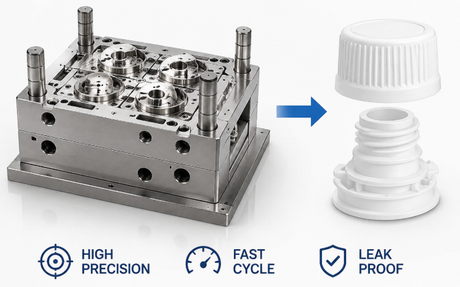
High-cavitation PP cap molds are widely used in beverage, household, personal care, chemical and refill packaging production. Buyers often focus on cycle time, cavity count and mold price at the beginning of a project. Those factors matter, but they do not fully explain whether the mold can run consistently after thousands or millions of molding cycles.
In high-speed PP cap injection molding, faster cycles expose weak points in the tooling system. Thread wear, sealing insert mismatch, poor venting, cooling imbalance, resin variation and unstable ejection may all appear as production defects. A cap mold should therefore be evaluated as a complete tooling system, not only as a set of steel parts.
Why High-Cavitation PP Cap Molds Are Sensitive to Cycle Time Reduction
TL;DR: Cycle time reduction is useful only when the mold remains stable. If cooling, ejection, venting or cavity balance is weak, a shorter cycle can increase flash, deformation, torque variation and inconsistent cap weight.
In PP cap injection molding, every second of cycle time affects production cost. This is why many closure manufacturers push high-cavity cap molds toward faster cycles. However, high-speed molding reduces the margin for process variation. A mold that looks acceptable at a slower cycle may become unstable when cooling time, holding time or ejection timing is shortened.
Cycle time reduction should be reviewed together with mold structure, resin behavior and component condition. For example, a slight cooling imbalance may not be obvious during trial molding, but it can create cavity-to-cavity shrinkage variation during continuous production. A worn sealing insert may also become more sensitive when injection speed or mold temperature changes.
From Production Pressure to Tooling Stability Requirements
TL;DR: High-volume cap production creates pressure on cycle time, cost and output. The mold must convert those production goals into stable cooling, sealing, threading, ejection and spare part control.
| Production Pressure | Common Tooling Risk | Tooling Stability Requirement |
|---|---|---|
| Shorter cycle time | Incomplete cooling, deformation or sticking | Balanced cooling, reliable release surfaces and stable ejection timing |
| High-cavity output | Cavity-to-cavity variation | Cavity-numbered inserts, consistent thread cores and inspection records |
| Lightweight cap design | Thin-wall deformation and smaller tolerance window | Accurate cavity inserts, controlled wall thickness and stable shut-off areas |
| Leak-proof closure demand | Flash or mismatch near sealing surfaces | Precision sealing inserts, controlled venting and stable parting-line fit |
| Long production campaigns | Wear, downtime and spare part mismatch | Interchangeable replacement components and repeatable machining references |
PP Resin Variation and Its Impact on Cap Mold Performance
TL;DR: PP resin variation can affect flow, shrinkage, part release and cap dimensions. A stable cap mold must tolerate reasonable material variation without losing sealing performance, thread fit or cavity balance.
PP is widely used for caps and closures because it offers a useful balance of stiffness, processability, chemical resistance and hinge performance for certain closure designs. But PP resin is not always identical from batch to batch. Melt flow, shrinkage, additive package, recycled content and moisture control can all affect how the material fills and releases from the mold.
When resin behavior changes, the mold areas most likely to show problems include thin cap walls, sealing lands, thread geometry, venting areas and ejection surfaces. If the mold has limited process margin, resin variation can appear as short shots, flash, sticking, cap weight drift or inconsistent torque.
For buyers sourcing high-cavitation PP cap molds, resin information should be part of the technical discussion before mold design is finalized. The supplier should understand the intended PP grade, expected production speed, cap application, sealing requirement and inspection standard before quoting or building the mold.
Critical Mold Areas That Control PP Cap Quality
TL;DR: PP cap quality is controlled by several mold areas working together. Thread cores, sealing inserts, neck rings, cavity inserts and ejection components each affect a different part of closure performance.
| Mold Area | What It Controls | Risk if Unstable |
|---|---|---|
| Thread Core | Opening torque, application torque and thread engagement | Torque variation, poor fit or unstable sealing |
| Sealing Insert | Sealing land, plug seal and leak-proof performance | Leakage, flash near sealing area or poor pressure resistance |
| Neck Ring | Cap-to-bottle fit and neck finish matching | Loose fit, uneven closure behavior or assembly issues |
| Cavity Insert | Outer geometry, surface quality and cavity repeatability | Cavity variation, deformation or inconsistent cap appearance |
| Ejection System | Release behavior and cap shape after ejection | Sticking, deformation, ejector marks or unstable cycle time |
Thread Cores and Torque Stability
Thread cores directly influence opening torque, application torque and thread engagement. In a high-cavity cap mold, small differences between thread cores can create different cap behavior from cavity to cavity. Buyers should review thread geometry, surface finish, wear resistance and replacement strategy before mass production. SENLAN supports cap mold components such as thread cores, cavity inserts and related precision parts for closure mold applications.
Sealing Inserts and Leak-Proof Performance
Sealing inserts affect cap leakage, pressure resistance and sealing land consistency. If the sealing area is unstable, the molding team may try to compensate with process changes, but the root cause may remain in the tool. A sealing insert should be checked for shut-off condition, venting, fit, polish level and cavity-specific wear.
Neck Rings and Cap-to-Bottle Fit
Neck rings help control the relationship between the cap and bottle neck finish. For beverage, sauce, chemical and personal care packaging, cap-to-bottle fit must remain stable across production batches. Neck ring wear or mismatch can create assembly issues, loose fit, leakage risk or unstable closure feel.
Cavity Inserts and Surface Consistency
Cavity inserts control outer geometry, cap surface quality and cavity repeatability. In lightweight cap designs, cavity insert accuracy becomes more important because the wall thickness window is smaller. Variation between cavity inserts can create visible appearance differences or uneven shrinkage behavior.
Ejection and Stripper Components
Ejection systems affect cycle time and cap shape after demolding. If release is unstable, faster cycles may create deformation, sticking, scuffing or ejector marks. Ejection should be reviewed together with cooling, polish level, resin shrinkage and cap geometry.
Cooling, Venting and Ejection: Why Faster Cycles Expose Tooling Problems
TL;DR: Faster cycles reduce the time available for heat removal, air escape and part release. This makes cooling balance, vent design and ejection reliability more important in high-cavitation PP cap molds.
Cooling is one of the main limits in high-speed cap molding. If one cavity cools differently from another, cap shrinkage and release behavior can become inconsistent. In high-cavity molds, cooling channels, insert contact, mold steel condition and local heat concentration should be reviewed as part of the mold design.
Venting is equally important. Poor venting can lead to burn marks, short shots, flow hesitation or flash in sensitive areas. Vent depth and location must be suitable for the resin, cap geometry and production speed. Vent design should not be treated as a minor detail after the mold is already built.
Ejection must also be stable. If the cap is not fully cooled or release surfaces are not controlled, the part can deform during stripping. For new mold projects, buyers should discuss plastic injection molding tooling requirements early, including cooling, ejection, parting-line location and maintenance access.
When Cycle Time Reduction Should Be Paused
TL;DR: A shorter cycle is not always a better cycle. If defects increase during speed-up trials, the team should review tooling condition before continuing to adjust molding parameters.
Cycle time reduction should be paused when faster molding creates cavity-specific flash, torque variation, sealing drift, sticking, cap deformation, unstable weight distribution or repeated defects in the same cavity. These symptoms often indicate that the issue is not only machine setting related.
Before pushing the mold to a shorter cycle, buyers and molding teams should review cooling balance, thread core wear, sealing insert condition, venting, resin consistency and ejection behavior. A practical speed-up plan should protect cap performance first, then reduce cycle time within a stable process window.
Cavity-to-Cavity Consistency in High-Cavitation Cap Molds
TL;DR: High-cavitation cap molds are judged by consistency, not only by total output. Each cavity should produce caps with comparable weight, dimensions, thread behavior, sealing condition and release performance.
In a high-cavity cap mold, one unstable cavity can create sorting work, downtime and customer complaints. This is why cavity identification and inspection records matter. If defects repeat in the same cavity, the team should be able to trace the related insert, thread core, sealing area or ejection component.
For long-term stability, buyers should ask how the supplier controls cavity-to-cavity consistency during machining, fitting, polishing, trial validation and spare part production. For projects involving precision mold components, replacement records and drawing control can be as important as the first mold trial result.
Replacement Components and Long-Term Mold Maintenance
TL;DR: High-cavitation molds need a spare part strategy before wear causes downtime. Replacement thread cores, sealing inserts, neck rings and cavity inserts should be made with controlled references and inspection records.
Cap molds often run for long production campaigns. Over time, wear may appear at the gate, thread core, sealing land, vent area, shut-off surface or ejection interface. If replacement components are not controlled properly, the repaired cavity may behave differently from the original cavity.
Buyers should confirm whether replacement components are cavity-numbered, whether matching relationships are recorded and whether inspection reports can be provided when needed. SENLAN can support custom machined mold parts for mold maintenance, replacement and modification projects based on drawings, samples and technical review.
Buyer Checklist Before Reducing PP Cap Mold Cycle Time
TL;DR: Before reducing cycle time, buyers should confirm whether the mold, resin and process are stable enough to support faster production. The checklist should include tooling, material, inspection and maintenance items.
- Confirm PP resin grade, melt flow range and expected shrinkage behavior.
- Review cooling balance across cavities before shortening cooling time.
- Check thread core wear, surface finish and cavity-to-cavity matching.
- Inspect sealing inserts for flash, shut-off wear and leakage-related defects.
- Confirm neck ring condition and cap-to-bottle fit requirements.
- Review venting in thin-wall, sealing and thread areas.
- Check ejection behavior for sticking, deformation or drag marks.
- Compare cap weight, dimensions, torque and sealing performance by cavity number.
- Prepare replacement components before long production campaigns.
- Define inspection report requirements before quotation or mold modification.
Regional Buyer Focus for High-Cavitation PP Cap Molds
TL;DR: Global buyers evaluate cap molds from different angles. European buyers often focus on sustainability and documentation, North American buyers focus on uptime and spare parts, and Southeast Asian producers often focus on long-cycle stability and high-volume production.
For European Closure Manufacturers
European closure manufacturers often focus on lightweight caps, tethered cap structures, material traceability, dimensional reports and long-term mold maintenance. For PP cap molds, thread stability, sealing performance and cavity-numbered inspection are important review points.
For North American Packaging Buyers
North American buyers usually care about production uptime, cycle time, high-cavity balance and spare component availability. Replacement thread cores, sealing inserts and neck rings should be planned before mold downtime occurs.
For Southeast Asian High-Volume Cap Production
Southeast Asian molding operations often run high-cavitation PP cap molds for long production campaigns. Cooling balance, resin variation, flash control and cavity-to-cavity consistency should be reviewed before aggressive cycle time reduction.
For South American and Middle East Packaging Projects
Buyers in South America and the Middle East often need stable closure performance, practical mold maintenance and reliable replacement support for beverage, household, cosmetic and chemical packaging projects.
How SENLAN Supports High-Cavitation PP Cap Mold Projects
TL;DR: SENLAN supports custom cap mold and mold component projects by reviewing part function, tooling risk, machining feasibility, replacement consistency and inspection requirements before production.
For high-cavitation PP cap molds, SENLAN’s engineering review can focus on the areas that directly affect production stability: thread cores, sealing inserts, neck rings, cavity inserts, venting zones, release surfaces and replacement components. The goal is to help buyers reduce repeated cavity defects, unstable cap fit, flash, leakage risk and downtime during high-speed production.
For new cap molds, modification projects or replacement tooling parts, buyers should send 2D drawings, 3D CAD files, cap application details, PP resin information, target cavity count, defect photos if available and inspection requirements. SENLAN can review machining route, tooling risk and quotation feasibility based on the supplied technical package.
FAQ
What is a high-cavitation PP cap mold?
A high-cavitation PP cap mold is an injection mold designed to produce many polypropylene caps in one cycle. It is commonly used for high-speed closure production where cycle time, cavity balance, cooling, sealing performance and spare part consistency are important.
How can buyers reduce cycle time in PP cap molding?
Buyers can reduce cycle time by reviewing cooling balance, resin behavior, venting, ejection, thread core condition and cavity-to-cavity consistency. Cycle time should not be reduced only by changing machine settings if defects begin to increase.
What causes flash in PP cap molds?
Flash in PP cap molds may come from worn shut-off surfaces, poor parting-line fit, excessive injection pressure, venting problems, sealing insert wear, resin viscosity changes or unstable clamping conditions. The root cause should be checked by cavity number.
Why does resin variation matter in PP cap injection molding?
PP resin variation can affect flow, shrinkage, release behavior, cap weight and dimensional stability. In high-cavity cap molds, material variation may expose weak points in cooling, venting, sealing and ejection.
Which mold components are critical for cap torque control?
Thread cores, neck rings and related cavity features are critical for cap torque control. Their geometry, surface finish, wear condition and replacement consistency can affect opening torque, application torque and thread engagement.
What should buyers send for a PP cap mold quotation?
Buyers should send 2D drawings, 3D CAD files, cap application, material grade, cavity count, expected production volume, sealing requirements, torque requirements, defect photos if available and inspection report needs.
Send Your PP Cap Mold Project for Technical Review
High-cavitation PP cap molds require coordinated control of mold design, cooling, ejection, resin behavior and precision mold components. If your cap production is affected by cycle time limits, resin variation, flash, torque drift, leakage or repeated cavity failure, prepare your drawings and project information for review.
Buyers can send drawings for cap mold review with 2D drawings, 3D files, PP resin details, cavity count, current defect photos and inspection requirements. This helps SENLAN evaluate mold structure, component risks, replacement strategy and quotation feasibility before production decisions are made.