Cap Mold Components for High-Speed Bottle Cap Injection Molding
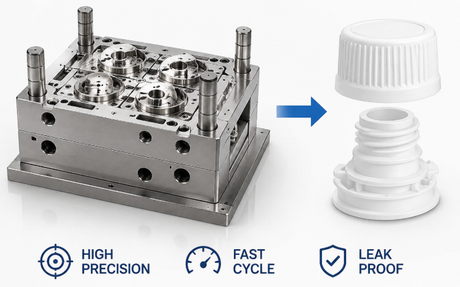
Quick Answer: Bottle cap injection molding is not only about machine speed or polymer selection. Stable closure production depends on precision cap mold components such as thread cores, sealing inserts, neck rings and cavity inserts. These components control sealing, torque, flash, ejection and cavity-to-cavity consistency in high-speed production.
Entity Statement: SENLAN manufactures custom injection molds and precision mold components for packaging, caps, closures, cosmetic packaging, medical-related molding and high-cavitation injection molding applications.
In high-speed bottle cap injection molding, closure quality is controlled by small tooling details. Thread core geometry, sealing insert accuracy, neck ring fit, cavity insert consistency, venting and parting-line stability all affect whether the final cap seals correctly, opens smoothly and runs consistently across multiple cavities.
For cap manufacturers, stable production depends on whether the mold components can control sealing, torque, flash and cavity-to-cavity consistency across long production runs. A mold may look correct in the CAD design, but if the components that form the thread, sealing land or neck fit are not stable, the production result can become inconsistent.
This guide explains how buyers should evaluate cap mold components, bottle cap injection molding tooling and replacement closure mold parts before approving new tooling or ordering spare components.
Why Bottle Cap Production Depends on Precision Mold Components
TL;DR: Bottle caps are small parts, but their mold components control critical functions such as thread fit, sealing, torque, tamper evidence, ejection and long-run consistency. Buyers should evaluate mold components by their function inside the mold, not only by nominal dimensions.
Bottle caps and plastic closures are used in beverage, food, pharmaceutical, household, personal care and cosmetic packaging. Their performance depends on several functional requirements: leak-proof sealing, controlled opening torque, stable thread engagement, clean appearance and consistent fit with the bottle neck.
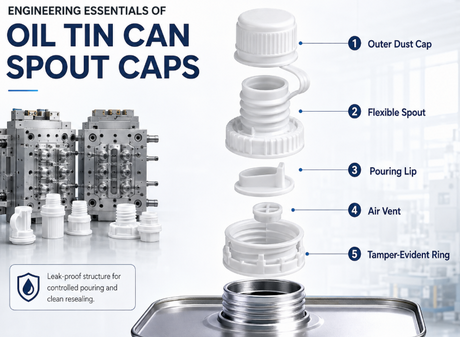
Each of these requirements is connected to a mold component. Thread cores form the internal thread. Sealing inserts define the sealing geometry. Neck rings affect fit with the container. Cavity inserts control the cap shape and surface. Stripper and ejection components influence release and cycle stability.
When buyers evaluate a bottle cap mold, they should not focus only on the mold base or machine tonnage. The smaller mold components often decide whether the closure can be produced repeatedly without flash, leakage, torque variation or ejection problems.
From Closure Requirements to Mold Component Requirements
TL;DR: Every closure requirement creates a tooling requirement. Buyers should translate sealing, torque, lightweighting and high-speed production goals into specific cap mold component specifications before ordering tooling.
| Closure Requirement | Possible Molding Risk | Critical Mold Component |
|---|---|---|
| Leak-proof sealing | Leakage, flash near sealing lands, unstable cap fit | Sealing inserts, neck rings, shut-off surfaces |
| Controlled opening torque | Thread variation, difficult opening, inconsistent assembly | Thread cores, cavity inserts, surface finish control |
| High-speed production | Cavity imbalance, short shots, cycle instability | Balanced cavity inserts, hot runner interface, cooling-related components |
| Lightweight closure design | Thin-wall deformation, flash, weak sealing | Core inserts, cavity inserts, neck rings, venting areas |
| Long-term mold maintenance | Replacement mismatch and repeated cavity failure | Cavity-numbered replacement components and inspection records |
Key Cap Mold Components Buyers Should Review
TL;DR: The most important cap mold components include thread cores, sealing inserts, neck rings, cavity inserts, core inserts, stripper plates and replacement inserts. Each component should be reviewed according to the closure function it controls.
Cap molds rely on multiple precision components working together. If one component wears, shifts or does not match the cavity correctly, the defect may appear as leakage, flash, torque variation, short shot, sticking or unstable cap fit.
Buyers sourcing cap mold components should review the following parts carefully:
- Thread cores: Control thread geometry, opening torque, application torque and assembly fit.
- Sealing inserts: Control sealing lands, plug areas, compression surfaces and leakage risk.
- Neck rings: Help define cap fit, bottle neck interaction and sealing consistency.
- Cavity inserts: Control external geometry, appearance, wall thickness and cavity-to-cavity consistency.
- Core inserts: Form internal geometry and affect ejection, shrinkage and part release.
- Stripper plates and ejection parts: Support fast demolding without deforming the cap.
- Replacement inserts: Help maintain long-term mold performance when wear-sensitive areas need service.
The correct inspection plan depends on which function the component controls. A thread core may need profile and surface review, while a sealing insert may need close attention to shut-off surfaces and dimensional fit.
How Thread Cores Affect Torque and Cap Fit
TL;DR: Thread cores affect the way a cap applies, opens and seals. Wear, dimensional variation or poor surface finish on thread cores can create torque variation and inconsistent cap performance across cavities.
Thread geometry is one of the most important features in bottle cap injection molding. The thread must match the bottle neck, support the correct closing force and allow the user to open the cap within the required torque range.
If a thread core has variation in thread depth, flank angle, pitch, surface finish or datum relationship, the molded cap may not behave consistently. In a high-cavity mold, small differences between thread cores can create cavity-to-cavity torque variation.
Buyers should define which thread dimensions are critical and whether inspection reports are required. For replacement thread cores, cavity identification and matching records can help reduce the risk of installing a component that meets the drawing but behaves differently inside an existing mold.
How Sealing Inserts and Neck Rings Affect Leakage
TL;DR: Leak-proof performance depends on sealing geometry and mold component condition. Sealing inserts, neck rings and shut-off surfaces should be reviewed for wear, dimensional accuracy, surface finish and replacement consistency.
Leakage is one of the most serious failure modes in cap and closure production. It may come from product design, material behavior or process settings, but tooling condition is often part of the cause.
Sealing inserts and neck rings help control the contact geometry between the cap and container. If the sealing surface is worn, mismatched or poorly inspected, the cap may look acceptable but fail pressure, vacuum or transport conditions.
Buyers should review sealing-critical mold components before production approval. Important checks may include sealing land dimensions, shut-off fit, insert flatness, venting near sealing areas, surface finish and wear condition after long production runs.
Material Selection: HDPE, PP and Recycled Resin in Cap Molding
TL;DR: Material choice affects flow, shrinkage, stiffness, torque, sealing and ejection. HDPE, PP and recycled materials may each require different tooling review and mold component attention.
Most plastic closures are produced from materials such as HDPE, PP or application-specific packaging polymers. HDPE is commonly used where stiffness and impact resistance are required, while PP is often used for closures that need hinge performance or higher heat resistance. Recycled resin and mono-material packaging trends can also influence material selection.
Material changes can affect mold performance. A resin with different shrinkage may change thread fit. A resin with different flow behavior may create flash in areas that previously ran well. Recycled material variation may influence surface quality, venting sensitivity and ejection behavior.
When buyers change resin grade, recycled content or material supplier, they should review critical mold components such as thread cores, sealing inserts, neck rings and cavity inserts. The drawing may remain the same, but the production window can change.
High-Cavity Cap Molds Need Cavity-to-Cavity Consistency
TL;DR: High-cavity cap molds require every cavity to produce the same closure behavior. Variation in one insert, thread core, sealing component or ejection detail can create different quality results across cavities.
High-speed bottle cap production often uses multi-cavity molds to achieve the required output. In these molds, cavity-to-cavity consistency is a major quality factor. If one cavity behaves differently, the molder may see cap weight variation, torque difference, flash, sealing instability or ejection problems.
Buyers sourcing precision mold components for high-cavity cap molds should ask how the supplier controls repeatability across components. Important controls include drawing clarity, datum references, cavity identification, inspection records and repeat manufacturing references for replacement parts.
For high-cavity production, mold components should not be treated as isolated spare parts. They should be controlled as part of a production system.
Cooling, Ejection and Cycle Stability in Bottle Cap Injection Molding
TL;DR: Fast cap production requires stable cooling and ejection. Mold component design affects cycle time, part deformation, release behavior and long-term production reliability.
Cycle time in bottle cap molding is influenced by filling, packing, cooling and ejection. While cooling design is part of the overall mold structure, mold components also affect heat transfer, release behavior and part stability.
Core inserts, cavity inserts and ejection-related parts should be reviewed for how they support fast production without damaging the cap. If the cap sticks during ejection or deforms before cooling is stable, cycle time may increase or reject rates may rise.
For new tooling projects, buyers can review plastic injection molding tooling capability together with the mold component requirements that affect high-speed closure production.
Replacement Cap Mold Components and Long-Term Maintenance
TL;DR: Replacement parts should be planned before production problems appear. Thread cores, sealing inserts, neck rings and cavity inserts may need cavity identification and inspection records for repeatable maintenance.
Cap molds often run for long production campaigns. Over time, wear may appear on thread cores, sealing areas, shut-off faces, ejection components and cavity inserts. If replacement parts are not controlled properly, the new component may solve one issue while creating another.
For replacement mold components, buyers should provide old part samples, cavity number, defect photos, mating-part information and inspection requirements where possible. This helps the supplier review whether the replacement component must match the original drawing, the current mold condition or both.
Projects involving custom machined mold parts should define whether interchangeability, manual fitting or cavity-specific matching is required.
Quality Control Checklist for Bottle Cap Mold Components
TL;DR: Quality control for cap mold components should focus on the features that affect closure function: thread geometry, sealing fit, shut-off surfaces, cavity balance, ejection behavior and replacement consistency.
| Quality Item | Why It Matters | What Buyers Should Check |
|---|---|---|
| Thread geometry | Affects torque, assembly fit and opening behavior | Thread profile, pitch, surface finish and datum control |
| Sealing surface | Affects leakage and cap-to-neck contact | Sealing land dimensions, shut-off fit and wear condition |
| Cavity insert consistency | Affects cap shape, wall thickness and appearance | Cavity dimensions, surface finish and inspection records |
| Neck ring fit | Affects cap fit and sealing behavior | Matching relationship and dimensional report requirements |
| Replacement component control | Reduces repeated cavity failure and fitting delay | Cavity ID, old sample, inspection report and material specification |
What Buyers Should Send Before Ordering Cap Mold Components
TL;DR: A complete RFQ helps the supplier review cap mold component function before pricing. Buyers should send drawings, CAD files, application details, material, cavity count, critical dimensions and inspection requirements.
Before requesting a quotation for cap mold components, buyers should prepare:
- 2D drawings with tolerance callouts
- 3D CAD files
- closure application, such as beverage, water, sauce, cosmetic or pharmaceutical packaging
- material grade, such as PP, HDPE or project-specific resin
- cavity count and expected production volume
- critical sealing dimensions
- thread geometry and torque requirements
- surface finish or coating requirement
- inspection report requirements
- defect photos if replacing worn parts
For technical review, buyers can send drawings for technical review with 2D drawings, 3D files, material details, cavity count, critical dimensions and inspection needs.
How SENLAN Supports Cap Mold Component Projects
TL;DR: SENLAN supports cap mold component projects by reviewing drawings, component function, machining feasibility, material requirements, inspection needs and replacement consistency before quotation.
SENLAN supports custom mold components and injection mold projects for caps, closures, packaging, cosmetic packaging and related high-cavitation applications. Project review may include thread core function, sealing insert requirements, neck ring fit, cavity insert accuracy, material behavior, inspection documentation and replacement component planning.
The goal is to help buyers connect each mold component with its production function. A thread core should be reviewed by torque and fit. A sealing insert should be reviewed by leakage risk. A cavity insert should be reviewed by consistency. A replacement component should be reviewed by matching condition and inspection needs.
FAQ: Cap Mold Components for Bottle Cap Injection Molding
What mold components are most important in bottle cap injection molding?
Key components include thread cores, sealing inserts, neck rings, cavity inserts, core inserts, stripper plates and replacement inserts. These parts affect sealing, torque, flash, ejection and cavity-to-cavity consistency.
How do thread cores affect cap quality?
Thread cores control thread geometry, opening torque, application torque and assembly fit. Wear or variation in thread cores can create inconsistent cap performance across cavities.
Why do bottle caps develop flash during injection molding?
Flash may come from parting-line wear, poor shut-off fit, insert mismatch, venting issues, excessive pressure or material flow changes. Mold components should be inspected before treating flash as only a process issue.
What should buyers send for cap mold component quotation?
Buyers should send 2D drawings, 3D CAD files, material grade, cavity count, critical sealing dimensions, thread geometry, surface finish requirements, inspection needs and current defect photos if replacing old parts.
Can replacement cap mold components be made interchangeable?
Replacement components may be made interchangeable when drawings, datum references, cavity identification, material specifications and inspection requirements are clearly defined. Existing mold wear may still require technical review.
Final Thoughts
Bottle cap injection molding is not only a matter of machine speed, cavity count or polymer selection. Stable closure production depends on precision cap mold components that control thread geometry, sealing surfaces, ejection, flash and cavity-to-cavity repeatability.
For cap manufacturers and packaging mold buyers, the right sourcing question is not only “Can this supplier make the part?” A better question is whether the supplier understands how each mold component affects sealing, torque, flash control, replacement consistency and long-term production stability.