
Views: 0 Author: Site Editor Publish Time: 2026-11-13 Origin: Site


Moving from prototyping to mass production forces a critical engineering decision. You must evaluate your tooling architecture carefully before cutting steel. A wrong choice leads to high capital expenditures, delayed market launches, and unacceptable defect rates. The mold itself represents a massive upfront investment. The initial design phase dictates your long-term manufacturing profitability.
Project managers and mechanical engineers often face a specific dilemma. Should you allocate your budget toward a multi-cavity tool or a family mold? Both strategies scale production output and maximize injection press efficiency. However, they serve entirely different manufacturing goals and yield vastly different financial outcomes.
This technical guide breaks down the mechanical, operational, and financial distinctions between these two primary mold types. We provide the analytical framework necessary to make the most profitable choice. This applies whether you are producing complex assembled consumer goods or investing in high-volume packaging solutions.
Multi-Cavity Molds: Ideal for producing massive volumes of identical parts. They deliver aggressive cycle times and consistent dimensional quality across millions of cycles.
Family Molds: Best suited for molding different components of a single assembly in one shot. They lower initial tooling costs but demand highly complex polymer flow balancing.
The Decision Matrix: Your final choice depends on total forecasted volume, geometric compatibility of the parts, and your upfront budget versus long-term return on investment.
Industry Standard: Mass-produced packaging components require dedicated, high-precision tooling to meet strict tolerance and yield requirements.
The injection molding landscape is shifting rapidly toward efficiency and material reduction. Packaging manufacturers face intense pressure to reduce resin usage while maintaining structural integrity. Lightweighting is now the undisputed industry standard. Thinner wall sections require higher injection pressures, faster cooling rates, and highly optimized tooling.
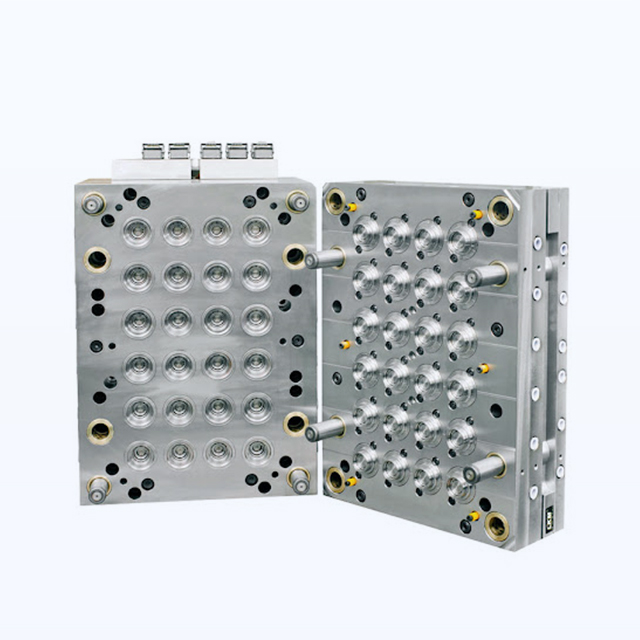
Consequently, engineers are moving away from cold runner systems in high-volume applications. Modern facilities favor advanced hot runner manifolds to eliminate sprue waste and shorten cycle times. Implementing a robust Multi-Cavity Cap Mold for Bottle production line addresses these exact trends. It maximizes throughput, minimizes material degradation, and ensures tight tolerances even with aggressive lightweighting designs.
A multi-cavity mold is a specialized tool containing several identical cavities machined into a single steel base. Molten polymer flows through the sprue, enters the runner system, and fills every cavity simultaneously. Instead of producing one part per cycle, this setup allows you to mold multiple exact replicas in a single shot.
The primary benefit of multi-cavity tooling is the drastic reduction in piece-part cost. Producing 16, 32, 48, or even 72 parts per cycle slashes machine time. This optimized cycle translates directly into lower energy consumption and reduced labor costs per unit.
Because all cavities share the exact same volume and geometry, achieving uniform cooling is highly efficient. Molding technicians can lock in holding pressures and injection speeds with confidence. Every cavity responds identically to process adjustments. This results in predictable shrinkage rates and exceptionally tight tolerances across the entire production run.
The most notable drawback is the initial capital expenditure. Machining dozens of identical, high-precision cavities into premium hardened steel like S136 or P20 requires hundreds of hours of CNC milling and electrical discharge machining. Higher initial tooling costs and longer manufacturing lead times are standard. You also need an injection press with higher clamping tonnage to keep the tool closed against the immense pressure of multiple filling cavities.
A family mold houses multiple different cavities within a single mold base. You mold an entire product assembly in one single injection shot. Think of a plastic electronic enclosure. The top housing, bottom case, and battery door all mold simultaneously.
The most appealing benefit is the significantly lower upfront tooling cost. You consolidate three separate mold bases into one tool. This setup guarantees a perfect color and material match for all assembled parts. They are molded at the exact same time from the exact same batch of polymer resin.
Beyond initial costs, inventory management improves drastically on the shop floor. Every time the mold opens, you receive one complete set of components. This eliminates the risk of overproducing one part while waiting on another to finish.
The critical risk of family molding lies in polymer rheology. Injecting molten plastic into different sized cavities simultaneously is mathematically challenging. Plastic naturally flows to the path of least resistance.
Imagine standing at the press watching the bottom housing flash while the battery door suffers a short shot. This is the reality of an unbalanced tool. Artificial balancing requires precise gate sizing and runner adjustments. If the system is not perfectly calibrated, smaller cavities fill first and over-pack. This inherent imbalance leads to internal stress, increased scrap rates, and frequent maintenance downtime.
Evaluating your options objectively requires a direct comparison across key manufacturing metrics. The table below outlines the operational realities of both tooling strategies.
Feature / Metric | Multi-Cavity Molds | Family Molds |
|---|---|---|
Cavity Geometry | 100% Identical | Different shapes and sizes |
Upfront Tooling Cost | High due to extensive machining | Moderate due to consolidation |
Cost Per Part | Extremely Low | Moderate to High based on scrap rate |
Ideal Volume | 100,000 to Millions of units | 10,000 to 50,000 assembled kits |
Runner Balancing | Naturally balanced | Artificially balanced and complex |
Quality Consistency | Exceptionally high | Moderate risk of over-packing |
To make a data-driven decision, project managers should evaluate their project against strict engineering thresholds before cutting steel.
Examine your sales forecast closely. If your anticipated volume exceeds 100,000 units per year, lean heavily toward multi-cavity tooling. The economies of scale quickly justify the higher initial tooling cost. The return on investment usually overtakes a family mold within the first few months of mass production. Conversely, if you only need 20,000 total assembled kits, a family mold is the smarter financial choice.
Analyze the physical characteristics of your components. If your parts have vastly different weights or varying wall thicknesses, avoid family molds. Molten plastic behaves unpredictably when forced into mismatched geometries. You cannot easily mold a bulky structural component alongside a delicate thin-walled bracket without severe quality compromises.
Consider the operational risks of tooling maintenance. If one cavity in a family mold breaks, production of the entire assembly halts until repairs are finished. You cannot sell half an enclosure. In contrast, if one cavity in a 32-cavity mold is damaged, technicians can block off the runner to that specific cavity. The machine continues running 31 parts, maintaining supply chain continuity.
Focusing specifically on the packaging industry reveals why precise tooling selection is non-negotiable. Beverage closures demand an unparalleled level of precision and speed. The internal threading must engage perfectly with the bottle neck finish to prevent carbonation loss. Tamper-evident bands require microscopic bridges that break consistently upon opening.
Attempting to use a family mold for this specific application is practically impossible. The cycle time would be severely bottlenecked by the thickest part, completely destroying economic viability.
Therefore, investing in a premium Multi-Cavity Cap Mold for Bottle system is the only viable path. High-quality SPI Class 101 molds built with hardened stainless steel ensure rapid speed-to-market. Cycle times often drop below five seconds. This enables beverage companies to produce billions of units annually with near-zero defect rates.
Selecting the wrong mold architecture cripples profitability. Avoid these costly shop-floor pitfalls.
Mistake 1: Chasing cheap tooling upfront. Many teams select family molds solely to preserve their capital budget. They end up losing substantially more money on high scrap rates, wasted resin, and constant machine adjustments. A cheap mold with a 15 percent scrap rate quickly becomes the most expensive asset on the floor.
Mistake 2: Ignoring hot runner systems. Running a high-cavitation tool with a cold runner system generates massive amounts of plastic waste. For complex applications, investing in a well-balanced Multi-Cavity Cap Mold for Bottle equipped with a hot runner manifold is essential. It injects plastic directly into the part, eliminating sprue waste entirely.
Mistake 3: Skipping mold flow simulation. Never guess how plastic will behave. Skipping flow analysis is a critical error. Advanced simulation software predicts pressure drops, identifies optimal gate locations, and proves whether a mold can actually be balanced.
Multi-cavity molds strictly dominate high-volume production. They offer unmatched consistency and lightning-fast cycle times for identical parts. Family molds provide a budget-friendly, consolidated solution for lower-volume assembled kits, provided the part geometries are highly compatible.
The ideal choice requires balancing your initial capital constraints with your long-term production goals. Carefully evaluate your volume, part design, and quality requirements to select the architecture that maximizes profitability.
Ready to scale your packaging production without compromising on quality? Explore the advanced engineering solutions at Senlan Molds. Contact an experienced injection molding partner today to design the perfect Multi-Cavity Cap Mold for Bottle project tailored strictly to your specifications.
High-quality steel molds rated as SPI Class 101 are engineered for extreme longevity. With proper preventative maintenance and regular cleaning, these molds reliably last for 1 million to over 5 million injection cycles before requiring major refurbishment.
No, this is not mechanically feasible. The mold base, cooling channel layout, and runner systems are fundamentally different. Transitioning to high-volume production requires engineering and machining an entirely new tool from scratch.
Multi-cavity molds are naturally balanced because all cavities possess the exact same geometry. Plastic flows symmetrically. Family molds require artificial balancing. Engineers mathematically adjust gate sizes and runner lengths so different-sized parts finish filling at the exact same millisecond.
Effective balancing starts long before cutting steel. Engineers rely heavily on mold flow simulation software to predict pressure drops. By analyzing the flow data, they adjust the runner diameters and restrict gate sizes on the smaller parts, forcing the molten plastic to fill the larger cavities at a proportional rate.
The maximum number depends entirely on the size of the injection press and the specific cap geometry. Modern high-production beverage closure molds commonly feature 48, 72, 96, or even 128 cavities. These require massive clamping tonnage and highly sophisticated hot runner controllers to maintain process stability.
A family mold is significantly cheaper upfront than building several separate molds for a multi-part assembly. However, a multi-cavity mold yields a much lower cost-per-part over the long run due to faster cycle times and optimized energy use.
Bottle caps are consumed in the billions globally. A single-cavity mold is far too slow and expensive per unit to meet market demand. High-cavitation tooling allows for the mass production of dozens of precise units every few seconds. It is the only economically viable option for the packaging industry.


