
Views: 0 Author: Site Editor Publish Time: 2026-11-13 Origin: Site


Scaling up plastic production without blowing up overhead costs is a daily battle for factory managers. Lead times cannot stretch. Quality must remain flawless. In the highly competitive plastics sector, finding this exact balance is critical to survival. Multi-cavity injection molding serves as a highly effective, practical solution for mass production. By engineering a system that produces multiple identical parts in a single machine cycle, this method fundamentally changes the manufacturing math. Output multiplies rapidly. Heavy machinery investments stay manageable.
A prime example of this high-volume efficiency is the Multi-Cavity Cap Injection Mold. It has become an essential asset for industries packaging beverages, cosmetics, and pharmaceuticals. Caps and closures are consumed in massive quantities every single day. Producing them one at a time is simply a waste of machine hours. This comprehensive guide explores how these advanced tools function and their proven cost-saving benefits. We will also dive into essential design optimization strategies and exact criteria for selecting the right manufacturing partner for your next high-volume project.
Unmatched Efficiency: Producing multiple parts per cycle exponentially increases output. This achieves higher volume efficiency compared to traditional single-cavity setups.
Cost Reduction: The initial tooling investment is notably higher. However, a multi-cavity system significantly lowers the cost-per-part over large runs by maximizing machine time and minimizing labor.
Design Matters: Advanced engineering features are non-negotiable. Optimized conformal cooling channels and balanced hot runner systems maintain consistent dimensional quality across every single cavity.
Strategic Investment: Choosing your cavity count depends entirely on production volume. For mass production, scaling up with multiple cavities is the only economically viable choice.
Partner Selection: Working with an experienced mold manufacturer ensures a durable tool. This maximizes your long-term return on investment.
Think of a multi-cavity system as a high-density production engine. A single steel mold base houses dozens of identical cavities. Depending on your production requirements and machine clamping force, these setups typically feature 16, 32, 64, or even 96 cavities. During the injection phase, molten plastic resin is forced under immense pressure through a central sprue. A carefully engineered network of runner channels distributes this pressurized liquid. Every cavity fills simultaneously. The plastic cools and solidifies. The mold opens, and dozens of identical parts drop out in one swift motion.
Bottle caps and closures represent a unique engineering challenge. They are high-demand consumables requiring exact precision. A deviation of just a few hundredths of a millimeter causes leaks. It can also prevent a cap from threading properly onto a bottle. Because caps are small yet required in the billions, they are perfect candidates for high-cavitation technology. This strategy allows manufacturers to meet massive global demand while holding the strict dimensional tolerances required for secure sealing.
Looking at recent industry shifts, the plastics sector is moving aggressively toward ultra-high cavitation systems integrated with smart technology. Raw material prices fluctuate constantly. Sustainability mandates push for lighter packaging. Manufacturers are moving beyond basic mechanical setups to stay competitive.
Specifically, the integration of in-mold IoT sensors is becoming a standard practice for premium tooling. These sensors monitor cavity pressure and cooling rates in real-time. This data-driven approach allows for dynamic machine adjustments on the fly. It ensures zero-defect manufacturing even in massive 96-cavity layouts. Furthermore, there is a massive push for lightweighting. Tooling engineers must now design molds capable of handling thinner wall sections without causing short shots or warping. This requires impeccable steel machining and superior hot runner thermal control.
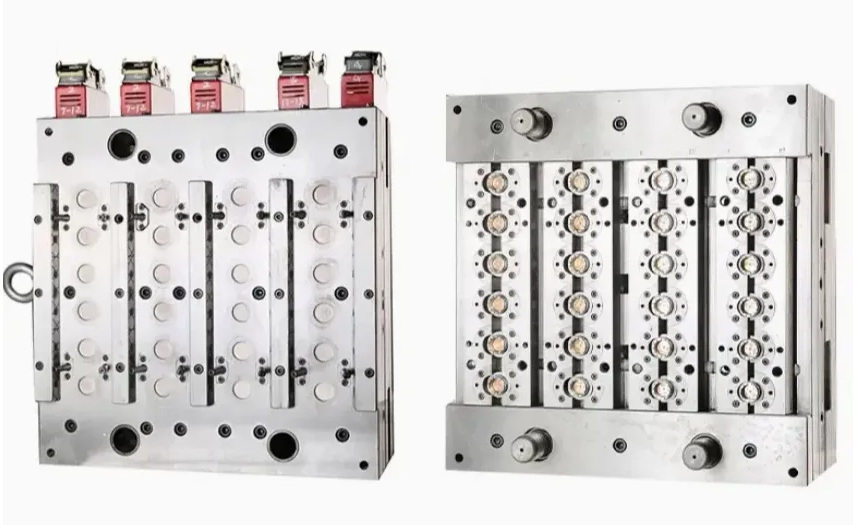
The primary advantage of upgrading your tooling is the dramatic reduction in overall manufacturing time. Cycle time remains relatively similar whether you use a single-cavity or a multi-cavity mold. For instance, a single-cavity mold operating on a 12-second cycle yields 300 parts per hour. In stark contrast, a 32-cavity mold running that exact same 12-second cycle yields 9,600 parts per hour. This exponential increase ensures facilities meet tight delivery deadlines without running machines 24 hours a day.
A common misconception is that producing more parts simultaneously leads to a drop in consistency. In reality, a well-designed mold enforces strict quality control. Advanced engineering ensures the exact same injection pressure, melt temperature, and cooling rate apply universally. Consequently, the cap produced in the first cavity is dimensionally identical to the cap produced in the thirty-second cavity. Maintaining this strict uniformity is essential for automated downstream assembly lines. Even minor defects will cause capping equipment to jam.
Scaling operations smoothly is a major hurdle for growing businesses. Relying on single-cavity molds for mass production requires purchasing dozens of separate injection machines. You also need a massive facility and numerous operators. High-cavitation molds circumvent this issue entirely. By maximizing the output of a single machine, businesses increase production capacity exponentially without a linear increase in capital equipment.
Despite the overwhelming benefits of high cavitation, single-cavity molds are not obsolete. They serve strategic purposes in the manufacturing lifecycle. They remain the standard choice for prototyping and testing new product designs. When a project requires highly complex parts with intricate undercuts necessitating complex slider mechanisms, a single-cavity mold keeps tooling costs manageable. It minimizes upfront financial risk.
For mass production, the long-term mathematics heavily favor multi-cavity tooling. The higher upfront cost of engineering and machining is quickly offset. You see massive reductions in machine time, energy consumption, and labor costs. Consider a scenario where you need to produce 10 million snap-on caps. Using a single-cavity mold takes years of continuous operation. A 64-cavity mold completes the same order in a fraction of the time.
Production Metric | Single-Cavity Setup | Multi-Cavity Setup Example 32-Cavity |
|---|---|---|
Initial Tooling Cost | Lower | Higher |
Output Per Cycle | 1 Part | 32 Parts |
Cost Per Part | High due to machine time | Very Low |
Ideal Application | Prototypes and Low Volume | Mass Production and High Volume |
The fundamental economic driver here is economies of scale. In plastic injection molding, you calculate the cost per part by dividing total production costs by the number of parts produced. Total costs include machine hourly rates, labor, overhead, and tooling amortization. Because a multi-cavity setup produces exponentially more parts in the same timeframe, the fixed hourly machine rate dilutes across a much larger number of units. This directly improves profit margins.
Modern multi-cavity systems are marvels of material efficiency. Traditional cold runner molds create a solid plastic framework alongside the actual parts. This scrap must be trimmed and reground, wasting time and degrading resin quality. In contrast, a high-performance multi-cavity snap-on cap mold utilizes advanced hot runner systems. These systems keep the plastic inside the runner channels molten. The plastic injects directly into the cavities. This eliminates the solid runner completely. Nearly 100 percent of your purchased resin goes directly into the final product.
Running one large mold on a single, appropriately sized machine is far more resource-efficient than dividing the workload. It consolidates energy consumption. You require less electricity to heat one barrel and operate one hydraulic system. It also streamlines labor. Operators only need to monitor, load hoppers, and maintain one machine.
The choice of runner system dictates the ultimate efficiency of your tool. While cold runners are cheaper to manufacture, hot runner systems are universally preferred for high-volume cap production. A hot runner maintains the polymer melt at a precise temperature right up to the cavity gate. This provides better flow dynamics and reduces the required injection pressure. Cycle times drop significantly. The cosmetic finish of the cap is also vastly improved.
Cooling accounts for the largest portion of the injection molding cycle. It often consumes up to 70 percent of the total time. Efficient cooling is paramount. Senior engineers utilize conformal cooling techniques. Highly optimized water channels are drilled to closely follow the specific geometry of the cap. Rapid, uniform cooling prevents the caps from warping. It guarantees dimensional stability while shaving valuable seconds off the cycle time.
Durability depends entirely on the construction materials. These molds endure immense clamping forces over millions of cycles. Top-tier advanced cap injection tooling relies on high-grade tool steels. For example, using premium S136 stainless steel for the core and cavity, hardened to HRC 48-52, offers exceptional wear resistance. It combats the corrosive effects of polymer outgassing. When paired with a precision needle valve hot runner, cycle times routinely hit the 10 to 12-second mark. The tool easily surpasses 3 million to 5 million shots without requiring major refurbishment.
Achieving a perfectly balanced fill is a complex engineering hurdle. The molten plastic must reach the center cavities and the outermost cavities at the exact same time, temperature, and pressure. If the fill is unbalanced, central caps become over-packed and stressed. Perimeter caps remain incomplete. Engineers solve this using Computer-Aided Engineering mold flow analysis software. Simulating the injection process allows designers to tweak runner diameters and gate sizes long before cutting any steel.
Defects halt mass production rapidly. Flash occurs when molten plastic seeps into the parting line between the mold halves. This creates a thin, razor-like layer of plastic on the cap edge. Conversely, short shots happen when plastic fails to fill the entire cavity. Preventing these issues requires exceptionally tight machining tolerances. Proper venting must also be intricately machined into the mold. Trapped air must escape. Without adequate venting, compressed air causes short shots or actually burns the plastic.
Even the most robustly engineered molds require systematic upkeep. Regular maintenance is non-negotiable for 24-hour operations. A standard hands-on checklist includes scrubbing cavities to remove sticky resin residue. You must lubricate moving parts like ejector pins to prevent metal galling. Inspecting cooling channels for mineral scale buildup is also critical. A strict preventative maintenance schedule dramatically extends the operational lifespan of the tool.
Not all mold makers are equipped to handle the rigorous complexities of high-cavitation tooling. When selecting a partner, evaluate their specific experience. You need a manufacturer who specializes deeply in high-volume cap production molds rather than a generalist plastics shop. True expertise means they intuitively understand thread stripping, tamper-evident band molding, and precise gate locations. These details are critical for functional closures.
A reliable manufacturer maintains transparent quality control protocols. Before a mold leaves their facility, they must conduct comprehensive trials. These initial sampling runs involve putting the mold in an injection machine to produce actual parts. The physical samples are then rigorously measured against 3D CAD models to verify dimensional accuracy. This ensures the tool is truly production-ready upon arrival at your plant.
The relationship should never end on delivery day. High-volume molds are significant capital investments. Evaluate the warranties offered. A reputable supplier guarantees the mold life for a specific number of cycles based on the steel grade. They must also provide accessible technical support, detailed maintenance documentation, and a reliable supply chain for replacement parts like hot runner nozzles.
Achieving higher volume efficiency relies heavily on the quality, precision, and design of the mold itself. Upgrading requires a larger initial capital investment. However, the dramatic reduction in cycle times, material waste, and cost-per-part makes it the undeniable strategy for mass production. By choosing the right runner systems, optimizing cooling, and partnering with a specialized manufacturer, businesses scale output effortlessly. If you are ready to elevate your manufacturing capabilities, explore custom multi-cavity solutions at Senlan Molds. Reach out to their engineering team today to review your designs and secure a custom quote tailored to your production demands.
The primary advantages include exponentially higher volume efficiency, a significantly lower cost per part, and faster overall production times. By producing multiple parts in a single machine cycle, manufacturers fulfill massive orders quickly while maintaining consistent part quality across the entire batch.
Depending on the specific grade of steel used, such as high-grade hardened S136 stainless steel treated to HRC 48-52, a premium mold lasts a very long time. With a strict facility maintenance routine, they are typically rated to perform anywhere from 3 million to over 5 million injection cycles before requiring major refurbishment.
Cycle times vary based on the cap design, wall thickness, and the efficiency of the cooling system. However, a well-engineered multi-cavity snap-on cap mold utilizing conformal cooling and a precision hot runner system typically achieves cycle times between 10 and 15 seconds.
As you increase the number of cavities, the total projected area of the plastic parts increases. This requires a proportionally larger injection molding machine with a higher clamping force to keep the mold halves securely shut during high-pressure injection, preventing flash defects.
Manufacturers rely on advanced mold flow analysis software during the initial design phase. By digitally simulating the flow of molten plastic, engineers fine-tune the geometry of the runners and gates. This ensures the plastic melt reaches every single cavity at the exact same pressure and temperature.
For high-volume cap production, a hot runner system is almost always the superior choice. It drastically reduces material waste by keeping the plastic in the runner molten. This eliminates solid runner scrap, decreases overall cycle times, and improves the cosmetic finish by providing a much cleaner gate mark.
Yes, but as the complexity of the part increases, the mold design becomes significantly more intricate. For extremely complex parts requiring multiple sliders or unscrewing mechanisms, the total number of cavities might need reduction to accommodate the moving steel components. For standard items like caps and closures, high-cavitation remains the standard industry practice.


