Views: 0 Author: Site Editor Publish Time: 2026-04-27 Origin: Site


Precision engineering is often described as making parts with tight tolerances. That is true, but for injection mold components, the meaning goes much deeper.
In a mold, a component does not work alone. A core pin, cavity insert, sleeve, thread core, neck ring, slider, or sealing insert must fit into a larger system. It must hold its position, resist wear, repeat its function, and support stable molding over thousands or even millions of cycles.
At SENLAN, we define precision engineering in injection mold components as the ability to control fit-critical dimensions, datum relationships, surface finish, material stability, and repeatability so that mold components can perform consistently in real production — not only pass inspection as individual parts.
This matters most in high-consistency molding applications such as medical consumables, bottle caps and closures, and skincare packaging, where a small deviation in a mold component can become flash, leakage, assembly problems, or cavity-to-cavity variation in the final molded product.
Precision engineering in injection mold components means more than machining a part to drawing. It usually involves:
A precision mold component is not only accurate as a single part. It must remain reliable inside the mold system.
For buyers comparing custom cores, cavities, inserts, sliders, core pins, sleeves, and thread cores, our custom precision mold components page gives a direct view of the component types SENLAN supports.
For many buyers, the difference between general machining and precision engineering is not obvious at first. Both may use CNC machines. Both may produce parts from drawings. But the engineering logic is different.
| General Machining | Precision Engineering for Mold Components |
|---|---|
| Focuses on making the part to drawing | Focuses on how the part fits and functions inside the mold |
| Checks individual dimensions | Checks datum relationships and functional surfaces |
| One good sample may be acceptable | Repeatability across cavities and batches matters |
| Manual fitting may be expected | Drop-in interchangeability is often the goal |
| Surface finish may be cosmetic | Surface finish can affect sealing, sliding, wear, and demolding |
In mold manufacturing, a part can look correct on paper but still create problems if the functional relationships are unstable. That is why precision engineering must consider the working condition of the component, not only its nominal dimensions.
Multi-cavity molds amplify small errors.
In a single-cavity mold, a minor issue may be easier to identify and correct. In a 16-cavity, 32-cavity, or higher-cavity mold, the same issue can become a production-wide problem.
For example:
This is why precision mold components are especially important in medical consumables, bottle cap molds, spout cap molds, cosmetic closure molds, and other high-cavitation tooling programs.
For high-cavity molds, the buyer is not only purchasing a machined part. They are purchasing production stability.
Core pins and sleeves are common in medical consumables, packaging components, caps, and small technical molded parts. They often control internal geometry, guiding surfaces, or thin molded features.
Precision concerns include:
A core pin that is slightly out of relationship with its locating datum may still pass a simple size check, but it may not perform correctly in the mold.
Cavity inserts and core inserts directly affect the molded surface, part dimensions, shut-off areas, and appearance. For skincare packaging or cosmetic caps, surface quality and parting-line control can be just as important as dimensional tolerance.
Important factors include:
For multi-cavity molds, inserts must not only be accurate individually. They must also match each other as a set.
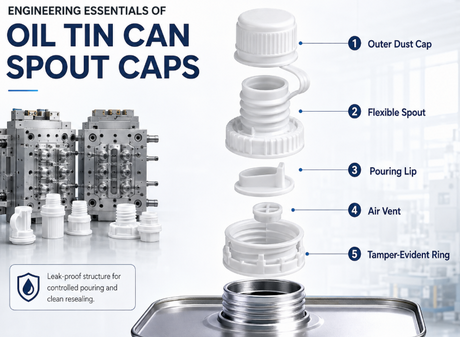
Thread cores and neck rings are critical in bottle cap molds, closure molds, spout cap molds, and fitment molds. These components influence thread engagement, closing feel, sealing pressure, and assembly consistency.
Precision engineering here must consider:
For cap and closure manufacturers, a thread core problem may not show up as a simple dimensional defect. It may show up as torque variation, leakage, or poor user experience.
Movable components introduce another layer of risk because they must move repeatedly while maintaining stable positioning.
For sliders, lifters, and movable core assemblies, buyers should pay attention to:
In complex molds, precision engineering must support both part geometry and mold movement.
Precision does not come from one machine alone. It comes from choosing the right process route and controlling each step.
CNC turning is often used for rotational mold components such as core pins, sleeves, bushings, thread cores, and neck rings. CNC milling is used for inserts, cavities, pockets, parting surfaces, and complex mold features.
The key is not simply whether CNC is used. The key is whether the machining route protects the functional datum and final fit.
EDM is important when the mold component includes hard material, sharp internal corners, deep ribs, narrow slots, or complex features that are difficult to machine conventionally.
Wire EDM is often used for precision profiles, inserts, and components requiring tight contour control. In high-precision tooling, EDM must be managed carefully because electrode wear, discharge parameters, and surface condition can affect the final part.
Grinding is often used after heat treatment to control final dimensions, flatness, roundness, or fit-critical surfaces. Polishing is used for mirror surfaces, demolding areas, sealing faces, and cosmetic surfaces.
For mold components, polishing is not only about appearance. It can affect:
Heat treatment helps improve hardness, wear resistance, and dimensional stability. But it also introduces risk if deformation is not controlled.
Surface treatments such as nitriding, DLC, TiN, or other coatings may be used depending on the resin, wear condition, and application. The key is to select treatment based on function, not simply because it sounds premium.
A good precision engineering process should consider how heat treatment and coating affect final dimensions.
For a broader view of SENLAN’s machining, EDM, grinding, polishing, and inspection foundation, see our ZEISS CMM inspection and precision machining capabilities.
Tolerance is important, but tolerance alone is not enough.
In injection mold components, the relationship between features often matters more than a single isolated size. That is why datum logic is critical.
For example:
In precision mold components, interchangeability means a replacement insert, core pin, sleeve, or thread core can be installed without extra bench fitting while keeping the same molding result.
This is especially important for overseas buyers because mold downtime is expensive. If a replacement component needs manual correction after arrival, the real cost is much higher than the part price.
Precision should not only be claimed. It should be measured.
For fit-critical injection mold components, inspection may include:
At SENLAN, ZEISS CMM inspection can be used to verify key dimensions and functional relationships on selected mold components. For defined critical features, tolerance control can reach ±0.005 mm depending on geometry, material, process route, and inspection requirements.
A good inspection report should confirm the dimensions that affect mold performance, not only list easy-to-measure sizes.
Medical consumables such as pipette tips, syringe components, diagnostic consumables, and small disposable medical plastic parts often require consistent mold performance.
Key concerns include:
Bottle cap and closure manufacturers rely heavily on precision mold components such as thread cores, neck rings, cavity inserts, sealing inserts, and unscrewing-related parts.
Key concerns include:
Skincare packaging parts often need both function and appearance. Caps, jars, closures, collars, and refill packaging components may require tight fit, clean surfaces, premium texture, and consistent visual quality.
Key concerns include:
For more product-use context, review our medical consumables, bottle cap, and skincare packaging mold applications.
Before sending an RFQ, buyers should clarify:
A clear RFQ helps the supplier propose the right process route instead of simply quoting from geometry.
Precision engineering is not only about making parts “more accurate.” It is about reducing production risk.
For injection molded product manufacturers, better precision mold components can help reduce:
This is why precision engineering should be treated as part of the production strategy, not only as a machining requirement.
A cheaper component may look acceptable at purchase stage. But if it causes fitting work, delayed mold trials, unstable molding, or repeated replacement problems, the real cost becomes much higher.
For buyers evaluating tooling routes together with molded product requirements, our custom injection mold tooling page provides related context.
Precision engineering in injection mold components is not a slogan. It is a practical discipline that connects design intent, machining route, material stability, surface condition, inspection, and long-term production performance.
For medical consumables, bottle caps, closures, and skincare packaging, the right mold components must do more than meet drawing dimensions. They must support stable molding, reliable replacement, and consistent final product quality.
That is the difference between a part that is simply machined and a component that is engineered for production.
If you are working on a fit-critical component, replacement insert, or multi-cavity mold part, you can send drawings for precision mold component review and quotation.
Precision engineering in injection mold components means controlling critical dimensions, datum relationships, surface finish, material stability, and repeatability so that mold parts perform consistently inside the mold system.
Multi-cavity molds need interchangeable components because variation in one cavity can affect part consistency, sealing, flash, torque feel, or assembly performance. Drop-in replacement helps reduce downtime and manual fitting.
Tolerance depends on the part function, material, geometry, and mold application. For selected critical features, SENLAN can control dimensions to ±0.005 mm when the design and inspection method support that requirement.
ZEISS CMM inspection helps verify critical dimensions and feature relationships, such as datum positions, flatness, concentricity, and cavity-to-cavity consistency. This gives buyers more confidence that the component matches its functional requirement.
The most useful RFQ package includes 2D drawings, 3D files, material, hardness, heat treatment or coating requirements, tolerance notes, surface finish requirements, quantity, and the component’s function in the mold.
#PrecisionEngineering #InjectionMoldComponents #PrecisionMoldComponents #CustomMoldComponents #CNCMachinedMoldParts #EDMMachining #ZEISSCMM #InterchangeableMoldComponents #MedicalConsumablesMold #BottleCapMoldComponents #SkincarePackagingMold #MultiCavityMoldComponents