Views: 0 Author: Site Editor Publish Time: 2026-04-13 Origin: Site


In packaging and medical mold projects, production risk does not always come from the largest mold plate or the most visible mold structure. Very often, risk starts from smaller fit-critical components: a core pin, sleeve, cavity insert, thread core, neck ring, sealing insert, or replacement component.
These parts may look small, but their influence is large. If a precision CNC part is slightly unstable in diameter, concentricity, datum relationship, surface finish, or interchangeability, the final molded product may show flash, leakage, assembly issues, torque variation, or cavity-to-cavity inconsistency.
At SENLAN, we define precision CNC parts for mold projects as custom-machined mold components that are controlled not only by size, but also by function, fit, repeatability, and long-run production stability.
For manufacturers of medical consumables, bottle caps, closures, refill packaging, and skincare packaging, this matters because one good sample is not enough. The real test is whether the mold can keep producing stable parts across repeated cycles, multiple cavities, and replacement-part changes.
Precision CNC parts reduce production risk by controlling the mold features that directly affect final product consistency.
In packaging and medical mold projects, precision CNC mold components help improve:
Precision CNC parts are not only machined components. In multi-cavity mold projects, they are part of production risk control.
For buyers comparing cores, cavities, inserts, thread cores, sliders, and replacement parts, our custom precision mold components page gives a direct overview of the component types SENLAN supports.
In injection molds, small components often control the most sensitive features of the molded product.
A small deviation in a CNC-machined mold component can create repeated defects during production. This is especially true in multi-cavity molds, where the same component type may be repeated 8, 16, 32, or more times.
| CNC Mold Part | Possible Risk if Unstable |
|---|---|
| Core pin | Flash, poor fit, wall-thickness variation |
| Sleeve | Ejection instability, wear, poor guiding |
| Cavity insert | Parting-line flash, surface defects |
| Thread core | Torque variation, thread mismatch |
| Neck ring | Sealing inconsistency, cap-fit issue |
| Sealing insert | Leakage or poor sealing contact |
| Slider / lifter | Release issues, wear, mismatch |
A component can pass a simple size check but still fail in the mold if its functional relationships are not controlled correctly.
In high-cavity molds, a small CNC part is not a small detail. It can become a repeated defect across thousands or millions of molded parts.
Packaging mold projects often involve high output, short cycles, visible surfaces, and functional closure requirements. In these molds, precision CNC parts directly affect production stability and product performance.
Bottle cap and closure molds rely heavily on precision CNC parts such as thread cores, neck rings, cavity inserts, sealing inserts, and unscrewing-related components.
The main risks include:
For a bottle cap manufacturer, these problems are not just quality issues. They can affect filling line performance, consumer opening experience, and customer complaints after delivery.
A precision thread core must do more than match the thread profile on paper. It must keep the same thread behavior across cavities and repeated production batches.
Skincare packaging molds usually need both dimensional stability and appearance quality. Caps, jars, collars, refill components, and cosmetic closures may have visible surfaces, polished areas, texture requirements, or fit-sensitive assembly features.
Precision CNC parts help reduce risks such as:
For skincare packaging, a part that functions correctly but looks inconsistent may still be rejected. This makes cavity inserts, core inserts, and polished mold components especially important.
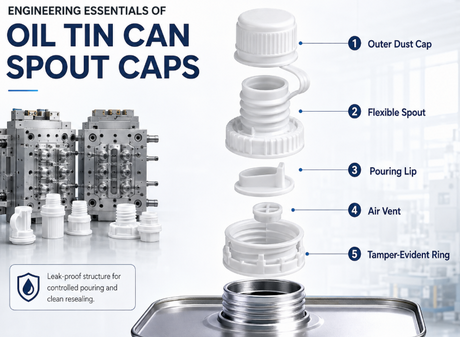
Refill packaging and spout cap projects add another layer of complexity because the cap, fitment, and pouch system must work together.
Precision CNC parts can affect:
In these projects, leakage is often a system problem. The cap may look acceptable by itself, but the assembly may fail if thread cores, sealing inserts, or fitment-related components do not hold stable relationships.
Medical mold projects place greater emphasis on consistency, traceability, and repeatability. For medical consumables, one acceptable sample does not prove production readiness.
Precision CNC parts used in medical molds may include:
Common risks include:
For medical consumables, a small mold component issue can become a recurring production risk. If a replacement part does not fit as expected, the mold may need extra correction, production may pause, and the buyer may need additional sample approval.
For medical consumables, one good sample is not enough. The real test is whether the same cavity performance can be maintained across repeat production and replacement cycles.
For more application context, review our packaging and medical mold applications.
Precision CNC parts reduce production risk when they are controlled around mold function, not only geometry.
Not every dimension on a mold component carries the same risk. Some dimensions only define shape. Others control fit, sealing, movement, alignment, or molded-part performance.
Fit-critical features may include:
A precision CNC part should be reviewed around the dimensions that actually affect mold performance.
For example, a sleeve may need diameter control, but it may also need stable concentricity and surface finish to prevent uneven wear. A thread core may need correct pitch, but also controlled runout and sealing-land relationship to avoid torque variation.
A common mistake is treating dimensions as isolated numbers.
In mold components, relationship control is often more important than single-size control. That means the supplier should understand which axis, face, or surface acts as the functional datum.
Important relationship checks may include:
A precision CNC part may pass individual dimensions but still fail in the mold if datum relationships are not controlled.
For buyers, this is one of the clearest signs of whether a supplier understands mold function or only follows the drawing mechanically.
In packaging and medical mold projects, replacement parts are often needed after wear, damage, or production adjustment. The question is whether those parts can be installed directly.
Interchangeability means a replacement CNC mold component can be installed without extra bench fitting while keeping the same molding result.
This is especially important for overseas buyers because mold downtime is expensive. A replacement insert or core pin that requires manual correction after arrival can delay production and create uncertainty.
Interchangeability depends on:
For high-cavity molds, interchangeable components help maintenance teams replace worn parts faster and reduce the risk of changing the molding result.
Surface condition is not only an appearance issue. In mold projects, surface finish can affect demolding, sliding, sealing, wear, and resin flow.
Depending on the application, precision CNC parts may need:
For packaging molds, surface quality may influence visible appearance, demolding resistance, or sealing stability. For medical molds, it may affect flash control, release behavior, and consistent forming of small features.
A good process plan should consider how finishing and surface treatment affect final dimensions. A component that is accurate before coating or polishing may not remain accurate afterward if the process is not controlled.
| CNC Mold Part | Common Applications | Risk It Helps Reduce |
|---|---|---|
| Core pins | Medical consumables, caps, packaging parts | Flash, poor fit, wall-thickness variation |
| Sleeves | Medical and packaging molds | Ejection instability, wear, guiding issues |
| Cavity inserts | Skincare packaging, caps, medical parts | Parting-line flash, surface defects |
| Core inserts | Packaging and medical components | Dimensional drift, molding instability |
| Thread cores | Bottle caps, closures, spout caps | Torque variation, thread mismatch |
| Neck rings | Cap and closure molds | Sealing inconsistency, assembly issues |
| Sealing inserts | Packaging and closure molds | Leakage, poor sealing contact |
| Sliders and lifters | Complex molded parts | Release issues, wear, mismatch |
| Replacement inserts | Multi-cavity production molds | Downtime, manual fitting, inconsistent repairs |
This is why precision CNC parts should not be treated as simple machined items. They are functional mold components that influence production behavior.
CNC machining is important, but it is only one part of a stable mold-component process.
A reliable precision CNC mold component may require several controlled steps:
Each step can improve the part, but each step can also introduce risk if not controlled.
For example:
Precision is not created by one machine. It is created by a controlled process route and verified by inspection data.
For a broader view of our machining, EDM, grinding, polishing, and inspection foundation, see our CNC, EDM, grinding, and ZEISS CMM inspection capabilities.
Inspection is where precision becomes verifiable.
For packaging and medical mold projects, buyers should not rely only on visual approval or sample appearance. Fit-critical components should be verified using the inspection method that matches the function.
Useful inspection items may include:
At SENLAN, ZEISS CMM inspection can support verification of key dimensions and functional relationships on selected precision CNC mold components. For defined fit-critical features, dimensional control can reach ±0.005 mm depending on part geometry, material, heat treatment, and inspection method.
The goal is not to measure everything equally. The goal is to measure what matters to mold performance.
A good inspection report should confirm the dimensions and relationships that affect production stability, not only the easiest sizes to check.
A stronger RFQ helps the supplier propose the right machining route and inspection plan.
Before asking for a quote, buyers should prepare:
If the part is used in a multi-cavity mold, it is also helpful to clarify whether interchangeability is required.
For replacement components, buyers should provide the approved sample, previous inspection report, or mold position information whenever possible.
Before releasing a precision CNC mold component order, check:
In packaging and medical mold projects, the right CNC mold components can help reduce:
This is the practical value of precision CNC parts. They are not only purchased to meet a drawing. They are purchased to keep mold performance stable over time.
A lower-cost part may look attractive at the RFQ stage. But if it causes rework, delayed trial approval, leakage, flash, or replacement problems, the total cost becomes much higher.
Precision CNC parts are small compared with a full injection mold, but they play a major role in production stability.
For packaging and medical mold projects, the best CNC mold components are not only accurate as individual parts. They are engineered to fit, repeat, wear predictably, and be replaced with confidence.
That is how precision CNC parts reduce production risk: by making mold performance more stable, maintenance more predictable, and long-run production less dependent on manual correction.
If you are working on a fit-critical CNC mold component, replacement insert, or multi-cavity mold part, you can send drawings for precision CNC mold part review.
Precision CNC parts are important because they influence sealing, thread consistency, visible surface quality, closing torque, and cavity-to-cavity balance. In packaging molds, small component variation can lead to leakage, flash, poor fit, or inconsistent user feel.
They reduce risk by improving fit-critical accuracy, repeatability, flash control, replacement consistency, and dimensional stability across multi-cavity production. For medical consumables, consistent mold performance is more important than one good sample.
Tolerance depends on the function of the part. Fit-critical features may require tighter control than non-functional geometry. For selected critical mold components, SENLAN can control defined features to ±0.005 mm when geometry, material, process route, and inspection method support that requirement.
Interchangeability means a replacement CNC mold component can be installed without extra bench fitting while keeping the same molding result. This helps reduce downtime and makes mold maintenance more predictable.
Send 2D drawings, 3D files, material, hardness, heat treatment, coating, surface finish, quantity, tolerance notes, and the part’s function in the mold. For replacement parts, also provide approved samples, mold position information, or previous inspection reports if available.
#PrecisionCNCParts #CNCMoldComponents #PrecisionMoldComponents #PackagingMoldComponents #MedicalMoldComponents #InjectionMoldComponents #CustomCNCParts #InterchangeableMoldComponents #ZEISSCMM #MultiCavityMold #BottleCapMold #MedicalConsumablesMold #SkincarePackagingMold