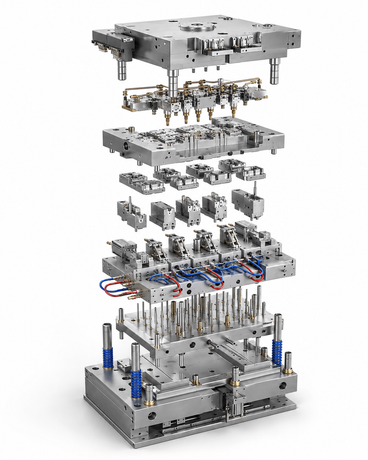
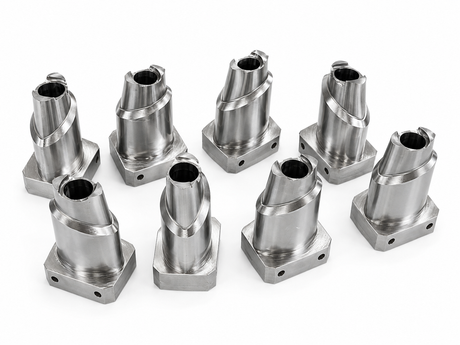
Custom Mold Components and Custom Tooling Solutions for Water Bottling, Skincare Packaging, and Medical Molds
When buyers source custom mold components or compare custom tooling solutions, they are rarely looking for generic machining. They are trying to solve specific production problems such as cavity-to-cavity variation, unstable sealing performance, inconsistent thread fit, excessive bench fitting during assembly, or weak documentation for medical mold components.
The right supplier does more than machine a part to drawing. It helps control CTQ features, protect interchangeability, and support repeatable mold performance with inspection-backed delivery.
What Custom Mold Components Mean in Real Production
In real mold projects, custom mold components are the parts that directly influence fit, release, sealing, thread engagement, and repeatability. Depending on the application, that may include core pins, cavity inserts, thread inserts, sliders, neck rings, and other precision mold parts that cannot be treated as standard hardware.
Custom tooling solutions go one step further. They combine part design understanding, machining route selection, inspection planning, and maintenance thinking. The goal is not simply to deliver a part that measures on drawing, but a part that works reliably in the mold, across cavities, and during repeat orders.
Learn more about our technical advantages in mold component machining and browse our plastic injection molding applications.
CTQ Priorities by Industry
| Industry | Typical CTQ Features | Common Risk | Why Custom Mold Components Matter |
|---|---|---|---|
| Water bottling | Sealing land, thread fit, concentricity, cavity-to-cavity consistency | Leakage risk, unstable cap fit, repeated fitting work | Stable inserts, core pins, and neck rings help reduce variation across cavities |
| Skincare packaging | Visible surfaces, contour continuity, thread smoothness, polishing allowance | Cosmetic defects, uneven closing feel, polishing-related distortion | Custom tooling protects both appearance and functional fit |
| Medical molds | Dimensional repeatability, traceability, inspection records, critical feature verification | Weak validation support, inconsistent repeat batches, documentation gaps | Inspection-backed custom mold components support repeat production and reviewability |
Water Bottling: Reducing Cavity-to-Cavity Variation in Cap Molds
In water bottling projects, the challenge is rarely making one acceptable cap. The challenge is keeping all cavities stable enough that sealing, thread fit, and assembly behavior remain consistent from cavity to cavity.
For these projects, buyers usually need more than machining capacity. They need custom mold components that support interchangeability, stable sealing performance, and easier mold maintenance.
Explore related caps mold components and review our 24-cavity bottle cap mold case study.
Skincare Packaging: When Appearance and Function Must Work Together
Skincare packaging molds have a different pressure point. The molded part must look premium, but it also has to open, close, seal, and assemble consistently. That means visible surfaces, cap feel, polishing allowance, and fit-related geometry all matter at the same time.
This is where custom tooling solutions become more valuable than standard mold parts. A well-planned process protects contour surfaces before polishing, controls fitting features before final finishing, and reduces extra correction work later.
View related cosmetic packaging mold components and our precision mold components homepage for broader application coverage.
Medical Molds: Why Documentation Is Part of the Product
Medical-related mold components usually require more than dimensional accuracy alone. Buyers also expect clearer verification, traceability, and confidence in repeat production.
In these projects, custom mold components and custom tooling solutions are often judged not only by machining results, but also by the quality of the supporting records: first article inspection, CMM reports, roundness or cylindricity data, material certificates, and outgoing inspection records.
Browse our medical mold components and inspection capabilities.
Process Route to Feature Control
| Process Route | Best Suited For | What It Helps Control |
|---|---|---|
| Hardinge CNC turning | Precision diameters, locating features, shaft-type parts | Diameter repeatability, concentricity, locating stability |
| Röders 3-axis milling | Complex cavities, contoured surfaces | Profile accuracy, contour consistency, fitting geometry |
| Makino EDM | Deep ribs, narrow slots, sharp corners | Hard-to-cut details, crisp geometry, stable forming |
| Sodick EDM / wire EDM | Hardened steel and fine features | Fine geometry control, detail stability after hardening |
| OD/ID, surface, and centerless grinding | Final size control and finishing | Roundness, concentricity, flatness, assembly consistency |
| ZEISS CMM and roundness equipment | Complex geometry and cylindrical CTQs | 3D dimensional verification and roundness/cylindricity validation |
Inspection Deliverables Buyers Should Request
Buyers do not only want to hear tolerance numbers. They want to know what documents will be delivered with the parts and how those numbers are verified in practice.
- First Article Inspection report
- CMM report for profile, location, or form-related features
- Roundness or cylindricity report for cylindrical fitting parts
- Material certificate
- Heat-treatment batch record
- Outgoing inspection record
- Surface finish verification record
Example Report Fields
Feature No. | Nominal Value | Actual Value | Deviation | Tolerance | Measuring Equipment | Inspector | Date
Supplier Evaluation Checklist
Before placing an order for custom tooling solutions, buyers can ask:
- What are the CTQ features on this part?
- Which process is used for those features and why?
- At what stage are they inspected?
- What report types can be delivered with shipment?
- How are repeat orders controlled for interchangeability?
- What material and heat-treatment records are available?
Have a new project? Send us your drawing, cavity count, CTQ list, material requirement, and inspection needs. We can review whether standard mold parts, custom mold components, or a more complete custom tooling solution is the better fit.
Related Topics Worth Reviewing
FAQ
How to reduce cavity-to-cavity variation in 24-cavity cap molds?
Focus on CTQ features that directly affect sealing, thread fit, and assembly consistency. In practice, this means tighter control of core inserts, thread-related geometry, matching components, and inspection checkpoints across all cavities.
What inspection reports should I request for medical mold components?
A practical starting set includes FAI, CMM reports for critical geometry, roundness or cylindricity reports for cylindrical parts, material certificates, heat-treatment batch records, and outgoing inspection records.
Collapsible core vs. unscrewing mechanism: when should I consider collapsible core?
A collapsible core is usually worth evaluating when internal undercuts or internal features make release difficult, and a simpler action sequence may improve repeatability or reduce mechanism complexity.
What makes custom tooling solutions different from standard mold parts?
Standard parts solve common functions. Custom tooling solutions are built around application-specific CTQs, machining routes, inspection plans, and maintenance needs.