Injection Molding Services for Packaging & Medical Projects
Powered by Precision Mold Components, CNC/EDM Machining & Inspection Support
We support injection molding programs through precision mold components, CNC/EDM machining, inspection, and trial support—especially for packaging and multi-cavity medical molds.
This page is designed for buyers who are not only looking for molded parts, but also need engineering support behind stable production.
Stable molding performance does not start at the press. It starts with the accuracy of the mold components, the quality of the machining route, and the consistency of the inspection system behind them.
SENLAN supports injection molding services through precision mold components, CNC/EDM machining, quality inspection, and spare-part control—rather than acting only as a conventional plastic parts subcontractor.
Quick trust points:
- Critical-feature machining capability down to ±0.005 mm under defined conditions
- Zeiss CMM-based inspection and ISO 9001:2015 quality control
- Packaging, caps & closures, and medical multi-cavity project experience
Get a Quote | Upload Drawing / Send RFQ
Where Our Injection Molding Services Fit Best
Our services are best suited for projects where molding performance depends on tooling precision, mold component stability, and repeatable replacement logic.
Best fit when your project includes:
- 32 / 48 / 64 cavity molds
- Sealing, thread, or shut-off CTQ risks
- Interchangeable replacement inserts or core pins
- Documentation needs for IQ/OQ/PQ or internal supplier approval
- Packaging, caps & closures, or medical mold applications
Less suitable when:
- You only need ultra-low-cost commodity molding
- The part is a non-critical prototype with no CTQ pressure
- Your project depends only on simple molded output, not tooling logic or inspection evidence
Decision Snapshot: How to Know If SENLAN Is the Right Fit
| What You Need | Why It Matters | How SENLAN Supports It |
|---|---|---|
| Multi-cavity repeatability | A small deviation in one cavity can affect the whole mold | CTQ-based component control and cavity-focused inspection logic |
| Replacement insert interchangeability | Bench fitting increases maintenance time and production risk | Precision mold component strategy aimed at repeatable replacement |
| Packaging / medical validation support | Engineering teams need evidence, not just promises | CMM-based reports, material / heat-treatment records, and sample documentation support |
| CNC / EDM route for fit-critical features | Wrong process route creates drift, flashing, or unstable fit | Process selection based on feature type, not just drawing shape |
DFM, Mold Component Strategy & CNC/EDM Route Planning
For many packaging and medical programs, stable molding does not begin with the press. It begins with how fit-critical mold components are reviewed, machined, inspected, and replaced.
That is why our engineering support focuses on:
- DFM review before production
- CTQ feature identification
- Mold component strategy for inserts, cores, cavity blocks, slides, and spare parts
- CNC / EDM / grinding route selection based on feature risk
- Inspection planning linked to mold function
Typical Workflow
- Upload Drawing / RFQ
- DFM Review
- Mold Component Strategy
- CNC / EDM / Grinding Route
- Trial & Inspection
- Batch Delivery & Spare Part Support
Why Precision Mold Components Matter in Injection Molding Services
Many injection molding pages focus on molding capacity. Our focus is different: stable molding depends on stable mold components.
Common production problems often trace back to:
- Thread cores with unstable sealing geometry
- Cavity inserts with dimensional drift
- Core pins that do not repeat across batches
- Replacement parts that require manual fitting
- Cavity-to-cavity mismatch in multi-cavity molds
This is why our injection molding support is built around precision mold components, machining logic, and inspection evidence—not only molded output.
For packaging and medical projects, stable production depends on more than having a mold. It depends on whether the mold components remain measurable, replaceable, and repeatable over time.
Quality & Inspection: Evidence You Can Review
For serious buyers, quality claims matter only when they can be reviewed, compared, and approved internally.
Our approach is designed around documentation that supports engineering review, supplier approval, and production control.
What we focus on
- CTQ-based measurement logic
- CMM verification for fit-critical dimensions
- Traceable dimensional records
- Replacement consistency for spare parts
- Inspection planning linked to mold function
What you may receive as sample evidence
- Dimensional reports with CTQ-marked features
- Cavity-to-cavity comparison logic for multi-cavity programs
- Material certification samples
- Heat-treatment record samples
- Replacement-part inspection examples
- Downloadable inspection report references
For packaging and medical tooling, good documentation helps teams move faster through technical approval and reduces uncertainty during trial, validation, and replacement.
Materials & Machining Logic
Material choice and machining route are closely connected in mold component performance.
SENLAN supports projects involving common mold steels and wear-sensitive applications where machining strategy directly affects stability, finish, and service life.
Typical component priorities include
- Wear resistance
- Corrosion resistance
- Sealing performance
- Polishing potential
- Dimensional stability after heat treatment
Our process route may involve
- CNC turning for roundness and diameter stability
- High-speed milling for form accuracy and controlled stock strategy
- Sinker EDM for detailed ribs, corners, and cavity features
- Wire EDM for profile-critical features
- Grinding for fit-critical surfaces and final stability
This route is selected based on risk, not only convenience.
Industries & Applications
Packaging Injection Molding
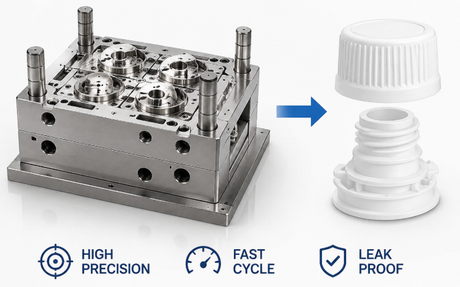
Stable tooling support for caps, closures, and packaging molds where cavity consistency and sealing performance directly affect output.
Medical Injection Molding
Precision mold components for medical applications where dimensional control, traceability, and repeatability matter.
Caps & Closures
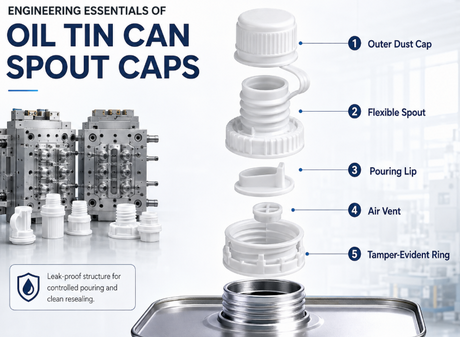
Support for thread cores, inserts, and sealing-related mold components used in high-output cap molds and flip-top systems.
Multi-Cavity Mold Projects
Component strategies and inspection logic designed for projects where one unstable cavity can affect the whole tool.
Case Examples
Case 1: Flip-Top Cap Sealing Stability
A packaging manufacturer had sealing issues on flip-top caps. The dimensional drift came from critical thread and sealing features on the core pins. By rebuilding the machining route around the CTQ thread features and linking inspection to assembly and leak-test results, sealing consistency improved and leakage risk was reduced.
Case 2: 32-Cavity Syringe Mold Core Stability
A medical project experienced cavity-to-cavity variation on hardened cores in a 32-cavity syringe mold. After revising the roughing and semi-finishing strategy and adding CMM-based checkpoints, cavity matching improved and flash was eliminated during trial molding.
Frequently Asked Questions
Do you provide CMM inspection reports for mold components?
For fit-critical and CTQ-controlled features, CMM-based verification can be part of the inspection route.
What tolerance can you hold on mold components?
Tolerance depends on feature type, material, geometry, and measurement method. The key question is which CTQ features need to be stabilized and verified.
Do you support interchangeable replacement inserts and core pins?
Yes, for suitable projects, the focus is on replacement consistency and lower fitting risk during maintenance.
What information do you need for a DFM review?
Part drawing, resin, target cavitation, and known CTQ features are usually enough to begin.
Do you support packaging and medical mold projects?
Yes. These are core directions for projects where mold component precision directly affects production stability.
Do you support low-volume and production-stage projects?
Yes, but the best-fit projects are those where engineering review, precision mold components, and stable production support matter more than simple unit price alone.
Start with a Structured Technical Review
For packaging, medical, and multi-cavity projects, early engineering input usually reduces more risk than a lower initial quote.
Send us:
- Your drawing
- Resin information
- Expected cavitation
- Known CTQ features
- Any validation or inspection requirements
In return, we can help identify:
- Manufacturability risks
- Likely mold component strategy
- Inspection and interchangeability needs
- Missing information required for a more accurate quotation
Request a DFM Checklist & Measurement Plan
Stop buying only molding capacity. Start buying production stability backed by mold component control, machining logic, and inspection evidence.