Views: 0 Author: Site Editor Publish Time: 2026-04-19 Origin: Site


At part level, a spout cap and a bottle cap can look similar. Both may use threads. Both may include tamper-evident details. Both need stable sealing. But from a tooling standpoint, they are not the same project.
A bottle cap mold is usually built around a rigid neck finish and a mature capping environment. A pouch spout cap is part of a spouted pouch closure system, where the cap has to work with a fitment, a flexible pouch, and real dispensing behavior in use. That changes what the mold has to optimize for, what can go wrong, and how the closure should be validated before production.
A rigid bottle gives the cap a stable reference geometry. The neck finish, sealing interface, and capping behavior are all tied to a hard container that does not deform much in normal use.
A spouted pouch closure works differently. The cap closes onto a fitment that is attached to flexible film, not to a rigid neck. That means the closure system is more sensitive to cap-fitment thread matching, sealing land geometry, and how the pouch behaves during filling, squeezing, transport, and repeated opening.
If you want to see how this difference looks from the spout side first, our custom spout cap mold product page is the best companion page to this article.
Most bottle cap mold programs are built around one core target: stable output at scale. The mold has to keep thread details, sealing surfaces, and cavity behavior consistent enough to support continuous production with limited adjustment.
That is why bottle cap mold reviews usually start with questions like cavity count, cycle expectations, maintenance access, and how to keep all cavities behaving the same way. If you want a concrete example of that kind of program, our 24-cavity bottle cap mold page shows the priorities more clearly.
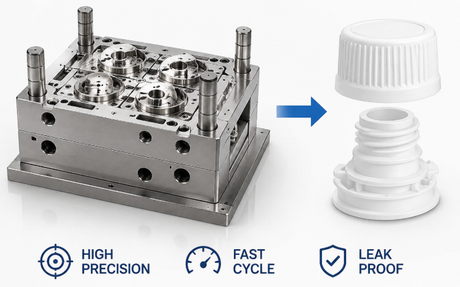
A spout cap mold has a different center of gravity. Instead of optimizing only the cap as a standalone part, the mold has to support a matched closure system.
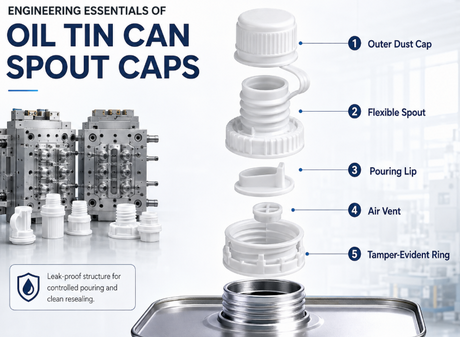
In a spouted pouch closure, the cap must engage the fitment correctly, create the intended sealing feel, deliver stable closing torque consistency, and keep tamper-evident behavior predictable. If the cap looks correct on its own but does not behave correctly on the matching fitment, the mold has not solved the real packaging problem.
For readers who want the definition side first, our spout fitment guide explains why the fitment cannot be treated as just another molded detail.
In a bottle closure, sealing is mainly tied to the cap and the bottle neck interface. In a pouch system, sealing is influenced by more variables: cap to fitment, fitment to film, pouch deformation, and the way the package is handled after filling. That is why spout closures are usually more sensitive to sealing surface decisions than standard bottle caps.
A bottle cap may tolerate small variation if the capping process is mature and the neck finish is consistent. A pouch spout cap is often more sensitive in the hand. Thread engagement, shrink variation, local flash, venting, and cavity variation can all show up as a different opening or reclosing feel.
Tamper-evident band break behavior can also be more demanding in pouch closures. Bridge geometry, material toughness, cooling balance, and interference with the fitment all affect whether the band breaks cleanly and consistently. In tooling, these areas often benefit from replaceable inserts and more careful maintenance logic.
Leakage in bottle caps and leakage in spouted pouches do not usually come from the same place.
In bottle cap projects, leakage often traces back to thread repeatability, sealing surface control, or cap-to-neck variation. In spouted pouch systems, leakage may also come from fitment geometry, fitment-to-film bonding, cap-fitment sealing mismatch, transport stress, or pouch squeeze behavior.
That is why a spout cap mold review usually has to look beyond the cap itself. In many refill-packaging projects, the better question is not “Does the part seal on the bench?” but “Does the assembled system keep sealing after filling, shipping, handling, and repeated use?”
The review process should start differently depending on which closure system you are building.
For a bottle cap mold, confirm:
For a spout cap mold, confirm:
What to send for a spout cap mold review
Send files or samples for a cap-fitment matching and sealing risk review before tooling is frozen.
This is where the difference becomes practical.
Bottle closure validation typically focuses on:
Spouted pouch closure validation typically adds:
If you want to see how this plays out in a real matched-set project, our cosmetic refill pouch application case covers the validation side in more detail.
It is easy to assume that both projects are just “cap molds.” But they are solving different packaging problems.
Bottle cap programs are usually about repeatability, output, and sealing stability on rigid containers. Spout cap programs are more often about system behavior: pouch, fitment, cap, and user experience all at the same time. That is why spout cap mold development usually needs a broader review window than bottle cap mold development.
For teams planning a new project, the faster route is usually to review the closure system early instead of trying to fix mismatch after tooling has already been cut. If you want to start that discussion, use our contact page.
Because the closure has to work as a matched system. Thread profile consistency, shrink behavior, flash, venting, fitment variation, and pouch-related handling effects can all show up as changes in opening or reclosing feel.
Any of the three may contribute. Leakage often comes from the interaction between cap-fitment sealing, fitment geometry, bonding to the pouch film, and the way the closure is assembled and used after filling.
Yes. Reviewing the cap and fitment together helps narrow the matching window earlier, improves sealing and torque consistency, and makes validation more meaningful before production tooling is finalized.
Not always in pure geometry. The bigger difference is usually in validation and system behavior. A spout cap mold often has more dependency on the matching fitment and pouch environment.
As soon as the cap must mate with a fitment, interact with flexible film, or be validated around dispensing, squeeze behavior, or pouch handling. At that point, it is no longer just a standard bottle closure program.