Views: 0 Author: Site Editor Publish Time: 2026-08-18 Origin: Site


Executable Insights Summary: Modern spout cap closure systems combine high-precision thread engagement, tamper-evident safety seals, and engineered mono-material polymers (HDPE/PP) to achieve leak-free fluid containment while slashing packaging material consumption by up to 70% compared to rigid containers. Utilizing high-efficiency tooling architectures like a specialized Spout Cap Mold for Spouted Pouches Refill Packaging enables ultra-fast cycle times, micrometric dimensional repeatability, and full compatibility with automated high-speed filling lines.
Functional Design Principles of Spout Caps
Sustainability and Material Circularity in Spout Cap Manufacturing
Tooling Architecture and Precision Engineering for Spout Cap Mold Solutions
Industrial Applications Across Global Refill Packaging Markets
Troubleshooting Defect Prevention and Maintenance Strategies
Conclusion and Future Industry Outlook

Functional spout cap engineering requires an integrated balance of sealing mechanics, ergonomic opening torque, and mechanical tamper-evidence to ensure leak-free performance throughout transport and end-user deployment.
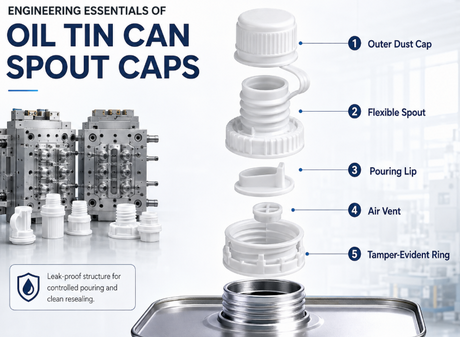
The primary performance failure in flexible pouch packaging occurs at the liquid interface. A spout cap closure does not function as an isolated component; it operates within a high-stress mechanical assembly comprising the welded fitment spout, the threaded cap body, and internal sealing lips. To achieve absolute leak prevention under dynamic transit vibration and thermal expansion, the internal bore seal (plug seal) and top seal surfaces must maintain uninterrupted compressive contact against the mating spout fitment. Precision dimensional control of thread pitch, lead angle, and root clearance is mandatory. A minimal thread engagement tolerance of 0.02 mm prevents cross-threading during automatic high-speed capping operations, which typically run at speeds exceeding 250 units per minute on modern rotary filling lines.
Mechanical tamper-evident (TE) bands represent another critical functional dimension. The breakaway bridge geometries must possess sufficient tensile strength to withstand high-speed capping torque without premature fracturing, while remaining delicate enough to fracture easily upon initial consumer opening. In European consumer markets, tethered cap regulations (such as EU Directive 2019/904) have forced a complete overhaul of TE band engineering. Modern closures must remain permanently attached to the spout housing via a flexible hinge strap post-opening. Achieving this structural requirement requires exact runner positioning, balanced cavity filling, and optimal gate placement within the Spout Cap Mold to avoid high-shear stress concentrators that cause premature hinge fatigue.
Furthermore, human factors engineering dictates the external ribbing profile and removal torque values. Ergonomic grip ribs molded around the cap circumference must provide high tactile friction without introducing deep shrink sinks or sharp parting lines that compromise consumer comfort. In infant food and pharmaceutical refill pouch applications, choke-proof safety caps with extended radial diameters and perforated air passages are legally mandated. These multi-featured geometries present unique mold design challenges, requiring intricate core side-actions and specialized stripping mechanisms to ensure clean, high-speed ejection without distorting thin-walled safety features.
Component Feature | Engineering Function | Critical Tolerance Range | Key Material / Process Metric |
Bore Seal (Plug Seal) | Primary inner liquid barrier preventing lateral bypass | ±0.015 mm interference fit | Radial wall thickness consistency |
Continuous Thread Profile | Axial compression force creation on top seal seat | ±0.020 mm pitch alignment | Symmetrical shrinkage control |
Tamper-Evident Bridges | Visual anti-counterfeit and safety verification | 0.12 mm to 0.18 mm bridge thickness | High-tensile shear break force (<1.8 Nm) |
Tethering Retention Strap | Anti-litter cap retention compliant with EU standards | >25 N pull-apart resistance | Flexural fatigue resistance (>50 flex cycles) |
External Tactile Ribbing | Manual grip enhancement for torque application | 0.30 mm depth draft angle >1.5° | Sink mark mitigation via wall uniforming |
Working Principle of Dual-Seal Spout Closures: The internal plug seal expands radially against the fitment inner wall while the top bevel seal creates an axial compression barrier; maintaining a balanced torque ratio between 1.2 Nm and 1.6 Nm during automatic capping ensures both seals activate simultaneously without causing plastic yield deformation.
Achieving circular sustainability in spout cap manufacturing depends on adopting mono-material polyolefin formulations, executing aggressive structural light-weighting, and validating post-consumer recycled (PCR) resin processing stability.
Historical spouted pouch packaging often combined aluminum laminates with multi-material closures, creating significant challenges for mechanical recycling streams. Modern sustainability protocols demand mono-material ecosystems where both the flexible pouch film and the rigid spout cap belong to the same resin family—predominantly High-Density Polyethylene (HDPE) or Polypropylene (PP). Converting entire closure assemblies to 100% HDPE allows the complete spouted pouch to enter standard PE film recycling streams without requiring manual separation. However, processing injection-grade HDPE presents distinct engineering challenges compared to PP, particularly regarding higher volumetric shrinkage rates, differential warping, and altered melt flow index (MFI) dynamics.
Light-weighting remains one of the most direct avenues for reducing carbon footprint per unit. Through advanced finite element analysis (FEA) and mold flow simulation, mold designers can eliminate superfluous wall thickness in non-structural regions while reinforcing load-bearing thread sections. Reducing a cap's weight from 2.8 grams to 1.9 grams across a production batch of 100 million units yields a raw material saving of 90 metric tons of polymer per year. However, wall thickness reduction severely narrow the processing window: thinner walls cool rapidly during injection, requiring higher injection speeds, elevated cavity pressures, and precise thermal control across the Spout Cap Mold layout to prevent premature gate freeze-off and short shots.
Integrating Post-Consumer Recycled (PCR) resin into high-performance closures represents another crucial step forward. PCR materials typically suffer from melt index variability, residual contaminants, and batch-to-batch property fluctuations. To maintain consistent dimensional tolerances and prevent environmental stress cracking (ESCR)—especially when packaging aggressive household surfactants or oils—mold construction must incorporate optimized core cooling and precise hydraulic clamping force control. Utilizing advanced multi-layer or co-injection technology allows virgin HDPE to form the food-contact and sealing surface layers while high-percentage PCR forms the structural internal core.
Performance Metric | Legacy Multi-Material Cap | Modern Mono-Material HDPE Cap | Optimized Lightweight PCR Cap |
Material Composition | PP Cap + PE Spout + PET Pouch | 100% Virgin HDPE Assembly | 50% PCR HDPE / 50% Virgin HDPE |
Average Unit Weight | 3.20 grams | 2.10 grams | 1.85 grams |
Carbon Footprint per 1k Units | 6.08 kg CO2e | 3.78 kg CO2e | 2.25 kg CO2e |
Recycling Stream Compatibility | Non-recyclable / Incineration | RIC 2 (HDPE) Rigid/Film Stream | RIC 2 (HDPE) Circular Loop |
Environmental Stress Crack Resistance | High (>100 hours) | Standard (>48 hours) | Engineered via additive blend (>60 hrs) |
Material Processing Tip for PCR Integration: When processing post-consumer HDPE blends above 30% loading, increase mold surface temperatures by 5°C to 8°C and optimize cavity venting depths to 0.015 mm to accommodate higher volatile gas release and prevent microscopic melt fractures.
High-efficiency spout cap production relies on specialized multi-cavity injection mold designs featuring balanced hot runner manifolds, optimized unscrewing or collapsible core mechanisms, and conformal cooling circuits.
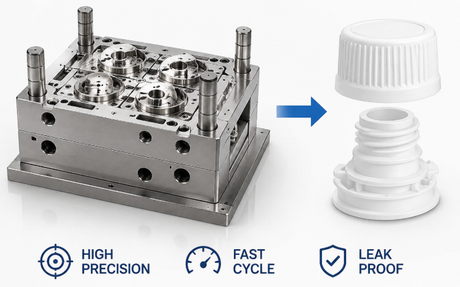
The economic viability of high-volume closure production requires maximum cavity counts—ranging from 16 to 64 cavities per mold base—operating at continuous cycle times under 6.5 seconds. Achieving uniform part quality across all cavities requires a fully balanced hot runner system equipped with individual tip temperature controls. Any pressure drop or thermal imbalance across the runner channels results in cavitation-to-cavitation weight variation, leading to inconsistent seal performance or thread binding during automated filling operations. Implementing a custom high-precision Spout Cap Mold for Spouted Pouches Refill Packaging ensures uniform melt distribution, minimal shear heating, and zero-vestige direct valve gating essential for high-throughput manufacturing.
Demolding internal cap threads represents a central mechanical challenge in closure mold construction. Two primary tooling methods are utilized: rotating unscrewing cores driven by hydraulic motors or servo-electric rack-and-pinion systems, and forced-stripping push-out mechanisms. Unscrewing molds offer superior thread detail, zero thread distortion, and accommodate complex, continuous thread geometries. Conversely, forced-stripping molds rely on the elastic memory of specific polyolefins (such as low-density modified PE or soft PP blends) to strip jump-threads off the core insert. Forced stripping eliminates complex mechanical unscrewing drive components, allowing tighter cavity pitch, smaller mold bases, and faster mechanical dry-cycle times.
Thermal management within the mold inserts directly dictates total cycle efficiency. Traditional straight-drilled cooling lines cannot reach the interior apex of small-diameter thread cores, leading to thermal hot spots, localized shrinkage defects, and extended cooling delays. Modern tooling incorporates 3D-printed metal conformal cooling inserts or high-thermal-conductivity Beryllium-Copper (BeCu) core pins. Conformal cooling channels follow the exact spiral contours of the cap thread profile, delivering uniform heat extraction across the part geometry. This advanced thermal engineering reduces overall cooling time by up to 35%, while eliminating post-molding cap warpage and seal ring ovality.
Tooling System | Technical Configuration | Operational Advantage | Target Production Volume |
Hot Runner Valve Gate | Direct cylindrical valve pin with titanium tips | Eliminates gate vestige, prevents stringing | High-volume (>10M units/year) |
Unscrewing Mechanism | Servo-electric gear drive with optical encoders | Precise thread formation, zero thread deformation | Complex continuous thread caps |
Forced-Stripping Cores | Segmented core sleeves with pneumatic assist | Compact mold base, rapid dry-cycle time | Standard snap-on or segmented thread caps |
Conformal Cores | Direct metal laser sintered (DMLS) 1.2709 steel | Uniform heat extraction, reduced cycle time | Ultra-thin wall lightweight closures |
Maintenance Tip for Hot Runner Valve Gates: Inspect valve stem seals and pneumatic actuating cylinders every 500,000 cycles; ensure concentric alignment within 0.005 mm between the valve pin and gate insert to prevent gate wear and flash formation.
Spout cap closures serve diverse market segments—including food and beverage, household care, personal hygiene, and industrial chemicals—demanding specialized structural configurations and compliance profiles for each application.
In the liquid food and beverage industry—covering fruit purees, baby food, dairy smoothies, and condiment refills—hygiene, hot-fill capability, and choke-proof safety dominate product requirements. Closures intended for hot-fill processes (typically executed at 85°C to 92°C) must retain structural rigidity without undergoing thermal softening or seal relaxing during vacuum formation upon cooling. Polymer formulations for baby food packaging must comply strictly with FDA and EU food contact regulations, maintaining absolute zero organoleptic impact to preserve product taste and aroma. Anti-choke cap designs featuring extended 33mm+ outer diameters with integrated air passage channels are widely mandated across European and North American markets to ensure child safety.
The household chemical and cleaning refill sector—encompassing laundry detergents, fabric softeners, and hard surface disinfectants—demands high chemical resistance and spill-proof dosing capability. Concentrated cleaning formulations often contain aggressive surfactants and solvent blends capable of inducing environmental stress cracking in standard polymers. Closures designed for refill pouches in this category frequently incorporate integrated measuring cups, directional pour spouts, or non-drip silicone valve inserts. The mold architecture for these multi-component caps requires precise multi-shot (2K) injection capabilities or secondary automated assembly lines to integrate soft elastomeric seal lips directly onto the hard HDPE cap body.
Personal care and cosmetic packaging—including liquid soaps, body washes, shampoo refills, and skincare serums—prioritizes premium visual aesthetics, soft-touch ergonomics, and controlled dispensing. European cosmetics markets show a strong preference for sleek, low-profile flip-top spout caps that allow one-handed operation in shower environments. Manufacturing these aesthetic closures requires mirror-polished mold cavity inserts (SPI A1 finish) and precise mold temperature control to eliminate flow lines, weld lines, and surface haze. Utilizing an advanced Spout Cap Mold for Spouted Pouches Refill Packaging allows manufacturers to achieve flawless surface aesthetics while maintaining the critical structural tolerances needed for automatic high-speed cap assembly.
Market Segment | Primary Material | Key Structural Feature | Compliance & Performance Standard |
Food & Baby Puree | Food-grade HDPE | Large Choke-Proof Profile + TE Band | FDA 21 CFR, EU 10/2011, EN 71 Safety |
Household Refills | ESCR-grade HDPE / PP | Drip-Back Channel + Measuring Lip | ASTM D1693 ESCR standard (>100 hrs) |
Personal Care | High-Clarity PP / Copolymer | Flip-Top Hinge + Soft-Touch Grip | SPI A1 Mirror Surface, 10k Hinge Flexes |
Agrochemical & Auto | PA-Lined / Fluorinated HDPE | Child-Resistant Push-Turn Lock | ISO 8317 Child Resistance Certification |
Hinge Design Rule for Flip-Top Spout Caps: To prevent hinge whitening and structural failure in polypropylene living hinges, ensure a hinge web thickness of 0.25 mm to 0.35 mm and flex the hinge immediately upon ejection while the resin retains residual molding heat.
Systematic defect troubleshooting and proactive mold maintenance protocols are essential for eliminating micro-leaks, flash formation, thread galling, and unscheduled line downtime.
In high-precision closure molding, minor processing deviations can lead to significant quality defects. Micro-leaking around the plug seal is typically caused by uneven thermal shrinkage or radial cavity deformation during ejection. If mold cooling is uneven, the circular plug seal distorts into a slightly oval geometry, compromising the interference fit with the mating spout. Mold flow simulation should be performed prior to steel cutting to evaluate volumetric shrinkage vectors. During production, mold technicians must monitor cavity pressure sensors to ensure peak packing pressures are maintained consistently across every cycle.
Flash formation along thread parting lines represents another recurring defect that impacts capping line efficiency. Thread flash occurs when localized cavity pressure exceeds the machine clamping force or when core unscrewing slides suffer mechanical wear. A parting line clearance greater than 0.012 mm allows low-viscosity resin melt to bleed into core shut-off faces. Preventing thread flash requires regular verification of platen parallelism, precise calibration of mold height settings, and routine replacement of brass or hardened steel wear plates within the unscrewing core drive mechanism.
Long-term tooling reliability requires a structured preventative maintenance schedule based on total operating cycles. High-speed closure molds operating on 5-second cycle times complete over 17,000 cycles per day. Maintaining tool integrity requires daily cleaning of mold parting surfaces, lubrication of moving slides with food-grade grease, and periodic ultrasonic cleaning of core inserts to remove resin outgassing deposits. Establishing a rigorous maintenance protocol extends tool life beyond 5 million cycles while ensuring consistent dimensional repeatability across multi-year production runs.
Defect Type | Root Cause | Process Optimization | Tooling Remediation |
Plug Seal Ovality | Non-uniform core cooling / premature ejection | Extend cooling time by 0.5s, lower core temp | Optimize spiral cooling or install BeCu core pins |
Thread Parting Flash | Worn slide lock plates / insufficient clamp force | Increase machine clamp force by 10% | Regrind core shut-off faces, replace wear plates |
TE Bridge Premature Break | High shear stress at gate / over-packing | Reduce injection speed during final cavity fill | Radius bridge sharp corners to 0.05 mm min |
Thread Stripping / Galling | Core rotation out of sync with ejector stroke | Calibrate servo motor resolver encoder feedback | Polish thread core surface to Ra 0.2 µm profile |
Preventative Maintenance Protocol (Every 1M Cycles): Perform complete disassembly of core unscrewing gear assemblies, clean all internal lubrication channels, inspect valve gate pin tips under 20x optical magnification for mechanical wear, and replace all Viton O-rings within the internal cooling circuits.
The continuous evolution of spout cap technology sits at the intersection of mechanical performance, advanced tooling engineering, and sustainable material design. As global regulatory bodies accelerate the transition toward a circular plastics economy, closure manufacturers must continuously optimize product geometries, adopt mono-material polyolefin formulations, and integrate post-consumer recycled resins. Achieving these demanding sustainability objectives without sacrificing functional reliability or capping line efficiency requires precision-engineered tooling architectures. Investing in high-performance mold designs—equipped with conformal cooling, balanced hot runners, and high-precision core unscrewing systems—enables high-efficiency production of lightweight, recyclable closures. By aligning functional excellence with circular design principles, liquid packaging manufacturers can meet rigorous sustainability standards while maintaining the uncompromising performance required by modern global markets.