Views: 0 Author: Site Editor Publish Time: 2026-08-08 Origin: Site


Section | Summary |
Engineering Essentials | Details the fundamental mechanics, structural anatomy, and anti-leak sealing principles of spout caps designed specifically for oil tin cans. |
Material Selection Criteria | Analyzes the chemical, mechanical, and thermal properties of polymers used in spout cap manufacturing, focusing on food safety and stress-crack resistance. |
Key Types of Oil Spout Caps | Outlines the primary structural classifications of spout caps, including telescopic, pull-ring, and tamper-evident designs tailored for commercial oil packaging. |
Precision Tooling and Mold Design | Explores the engineering requirements for Spout Cap Mold development, highlighting mold steel, hot runner design, and core cooling efficiency. |
Manufacturing and Quality Assurance | Details high-speed injection molding parameter optimization, defect mitigation, and strict quality assurance protocols for mass cap production. |
Installation and Sealing Mechanics | Explains the mechanical crimping, snap-fit pressing, and assembly automation processes required to achieve a hermetic seal on metal tinplate necks. |
Sourcing and Procurement Strategy | Reviews practical evaluation criteria, cost-efficiency frameworks, and technical alignment guidelines for selecting spout cap and tooling suppliers. |

Oil tin can spout caps are high-precision closure systems engineered to form an airtight, leak-proof mechanical seal with metal containers while providing controlled liquid dispensing and contamination resistance.
The closure interface of an edible or industrial oil tin can operates under demanding physical conditions. Unlike standard beverage bottles, edible oils, lubricants, and chemical solvents exhibit low surface tension and varying viscosity profiles. Low surface tension allows liquids to creep through microscopic gaps along the container neck thread or crimp joint. Therefore, an oil spout cap cannot rely solely on simple thread contact. It must incorporate an integrated sealing system, typically utilizing an inner plug or a continuous flex-lip that deforms against the tinplate orifice under specified torque or insertion pressure.
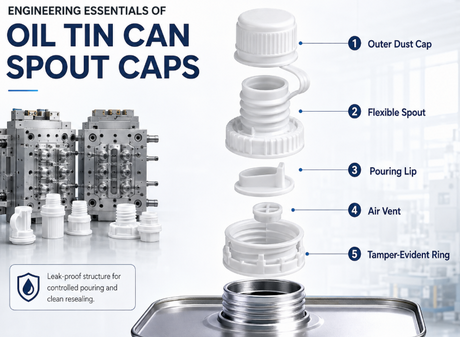
From a structural engineering standpoint, a professional spout cap assembly comprises five core components:
The Outer Dust Cap: Safeguards the pouring interface against ambient dust, moisture, and external contamination during warehousing and transit.
The Telescopic Flexible Spout: A collapsible, bellows-style neck that expands during dispensing to offer directional pouring control and retracts flush with the top plate of the tin can to optimize stacking efficiency.
The Integrated Pouring Lip: Designed with a sharp, thin edge geometry that cuts fluid surface tension cleanly upon cessation of pour, preventing drippage down the exterior metal wall.
The Air-Vent Mechanism: Integrates an anti-gurgle internal channel or dual-path airway that allows atmospheric air to enter the tin can as oil exits, maintaining balanced internal pressure and enabling smooth, continuous discharge.
The Tamper-Evident Tear Band or Pull Ring: A security mechanism molded directly into the structure with calibrated break-tabs, ensuring visual evidence of initial opening.
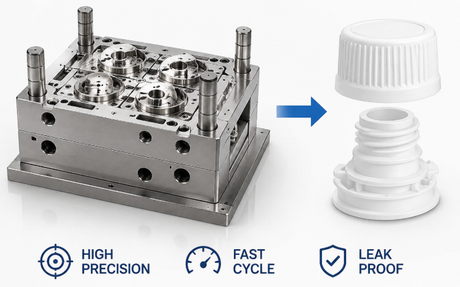
When evaluating these functional components, manufacturers must consider the dimensional stability of the molded parts. Achieving consistent wall thickness across complex geometry requires superior tool design. Tooling engineers must design dedicated multi-cavity tooling systems such as a customized Spout Cap Mold to ensure that microscopic sealing lips maintain roundness, wall thickness uniformity, and tight tolerances across multi-million-unit production runs.
Choosing the correct polymer for spout cap manufacturing requires balancing chemical compatibility, stress-crack resistance, environmental durability, and melt-flow performance during injection molding.
Polymer selection dictates both the short-term sealing performance and the long-term shelf-life integrity of packaged oils. Because oils contain fatty acids, hydrocarbon chains, or organic additives, they can interact with low-grade plastics, leading to plasticizer migration, polymer swelling, or Environmental Stress Cracking (ESC).
The primary polymers deployed in high-performance spout cap production include:
Low-Density Polyethylene (LDPE): Offers flexibility, high impact resistance, and elongation characteristics. It is the preferred material for the collapsible flexible spout section, allowing the spout to extend and bend repeatedly without cracking or stress whitening.
Linear Low-Density Polyethylene (LLDPE): Frequently blended with LDPE to increase tensile strength, puncture resistance, and environmental stress-crack resistance while preserving flexibility.
High-Density Polyethylene (HDPE): Provides structural rigidity, low moisture permeability, and high chemical resistance. It is predominantly used for rigid retaining rings, threaded bases, and structural overcaps that must withstand high mechanical top-loads during container stacking.
Polypropylene (PP): Demonstrates flexural fatigue resistance, making it suitable for live-hinge cap closures, dust covers, and threaded caps that require precise thread engagement and thermal stability during hot-filling processes.
When formulating resins, additives must strictly comply with international food-contact regulations such as FDA 21 CFR 177.1520 and EU Regulation No 10/2011. Lubricants, slip agents (such as erucamide or oleamide), and color masterbatches must be non-migratory to prevent chemical off-tastes or cloudiness in high-purity edible oils. Furthermore, mold shrinkage factors must be accurately calculated during the initial Spout Cap Mold design phase. Polyethylene exhibits shrinkage rates ranging from 1.5% to 3.0%, depending on cooling rates, melt temperature, and gate placement.
Technical Note (Design Rationale): In modern oil packaging engineering, we intentionally specify dual-material or co-molded spout cap systems over single-material designs. While single-material caps reduce initial tooling cost, dual-material structures allow us to use rigid HDPE for structural thread retention while utilizing flexible LLDPE for internal sealing lips. European clients consistently favor this dual-polymer architecture because it guarantees zero-leakage performance under extreme thermal fluctuations encountered during intermodal maritime shipping.
Oil tin can spout caps are classified by their mechanical deployment methods, dispensing control mechanisms, and anti-tampering features.
Selecting the optimal spout cap configuration depends on the viscosity of the fluid, the container capacity, the target end-user demographic, and filling-line automation capabilities.
Telescopic pull-up spout caps are the industry standard for 1-liter to 20-liter oil tin cans. These caps remain recessed below the tin can top-plate collar during shipping and display, protecting the closure from lateral impacts and enabling vertical container stacking. Upon consumption, the end-user pulls a integrated ring to elevate the flexible bellows outward, creating an extended spout that directs fluid away from the tinplate rim.
Fixed threaded spout caps feature a rigid neck crimped directly onto the tin lid orifice. These closures are common on large industrial oil cans, lubricant jugs, and chemical solvent drums where container stackability is secondary to continuous, heavy-duty dispensing. They accommodate secondary accessories such as flexible extension hoses, pump dispensers, or external metering spouts.
Press-in caps feature an internal diaphragm sealed with an integrated pull ring. To initiate flow, the consumer removes the outer dust cap, inserts a finger into the pull ring, and tears away the internal seal along a thin, micro-molded scoring line. The integrity of this scoring line is critical: if it is too thick, the user experiences excessive tear resistance; if it is too thin, hydraulic pressure surges during transport can rupture the seal.
Specially designed for high-value culinary oils (such as extra virgin olive oil, sesame oil, and specialty seed oils), these caps incorporate dual-lipped pour spouts paired with internal oil-return channels. Any residual fluid remaining on the pouring lip after dispensing is drawn back into the container via capillary action, eliminating messy residue on the exterior container surface.
High-precision Spout Cap Mold architecture dictates part dimensional tolerances, cycle time performance, parting line precision, and long-term production profitability.
Injection mold manufacturing for spout caps demands tight machining tolerances and high-grade metallurgy. Because spout caps contain fine threads, undercut snap-fit grooves, thin-walled flexible bellows, and internal sealing lips, the molding tool operates under severe thermal and mechanical stresses.
Tool steels used in spout cap production must resist mechanical wear, high cycle fatigue, and chemical oxidation caused by polymer additives. Premium molds utilize mirror-polished grade S136 or ASSAB 8407 stainless steel hardened to Rockwell C 48–52 for core and cavity inserts. Corrosion resistance is paramount because volatile gases released during PE processing can etch cavity surfaces over time, dulling cap gloss and altering microscopic lip dimensions.
Modern high-cavitation spout cap molds (ranging from 16 to 64 cavities) rely on fully balanced hot runner systems equipped with individual valve gates. Valve gating ensures pinpoint gate cuts without leaving residual gate nubs that could interfere with cap assembly, sealing mechanics, or dust cover fitment. The hot runner manifold must maintain uniform thermal distribution across all drop nozzles to prevent differential thermal expansion and cavity-to-cavity weight variations.
Cooling accounts for up to 70% of the total injection molding cycle time. Traditional straight-drilled cooling channels often fail to reach deep core areas that form the internal geometry of telescopic spouts. Advanced toolmakers deploy 3D metal printing to construct conformal cooling channels that closely trace the internal contour of the core. This approach accelerates heat removal, maintains uniform mold wall temperature, eliminates internal residual stress, and prevents part distortion or warpage upon ejection.
Forming internal threads, external retention beads, and tamper-evident band teeth requires custom ejection engineering. While coarse external threads can be stripped mechanically using stripper plates, fine internal threads require rotating core mechanisms driven by hydraulic racks or servo motors embedded within the mold base. For flexible LDPE pull-up spouts, forced stripping utilizing segmented collets or air-assist ejection plates allows the elastic material to deform over undercut geometry without tearing or scoring critical sealing surfaces.
To produce caps that reliably pass strict burst and leak testing, brand owners must partner with specialized tooling manufacturers capable of manufacturing high-precision mold systems like a custom Spout Cap Mold engineered specifically for oil packaging closures.
Achieving zero-defect manufacturing in spout cap production requires precise control of processing parameters, inline optical inspection, and rigorous mechanical performance testing.
High-volume spout cap production demands stable processing windows. Key variables include:
Melt Temperature: Maintained within tight limits (e.g., 190°C to 220°C for LLDPE) to ensure optimum polymer chain mobility without inducing thermal degradation.
Injection Velocity: High-speed, multi-stage injection profiles fill thin-walled bellows sections rapidly before polymer freezing occurs at the gate.
Holding Pressure and Time: Carefully calibrated to compensate for volumetric material shrinkage without over-packing the gate, which can induce stress concentration and leading to post-molding cracking.
Common molding defects in spout caps, along with their engineering remedies, include:
Flash at Parting Lines: Caused by insufficient mold clamping force or thermal expansion of core inserts; resolved by re-spotting the mold parting surface and optimizing injection pressure.
Short Shots in Thin Bellows: Occurs when melt fronts freeze prematurely in narrow wall sections; mitigated by increasing cavity wall temperature, enhancing vent depth (target 0.015 mm to 0.025 mm), or increasing injection speed.
Ovality / Warp: Caused by uneven cooling across core halves; resolved by balancing conformal cooling fluid flow rates and extending in-mold cooling times.
To ensure market reliability, finished spout cap batches must pass automated and laboratory-based quality assurance protocols:
Vacuum Decay Leak Testing: Caps are mounted onto pressurized test fixtures submerged in water or placed inside vacuum chambers to verify that internal sealing lips sustain negative pressure (-0.08 MPa) without micro-leakage.
Pull-Ring Tensile Failure Testing: Evaluates the force required to detach the tamper-evident pull ring or tear open the internal diaphragm, ensuring user-friendly operation without premature tearing during high-speed capping operations.
Torque Engagement and Stripping Tests: Measures both the application torque required to seat threaded caps and the over-torque threshold that causes thread stripping.
Tip for Maintenance Engineers: Inspect mold venting channels every 100,000 cycles. Microscopic polymer off-gas deposits accumulate rapidly in vents during high-speed LLDPE processing. Clogged vents cause localized micro-dieseling (burning) and short shots on thin sealing lips, compromising seal integrity.
Securing a spout cap to a metal oil tin can relies on controlled mechanical deformation, snap-fit interference, or peripheral metal crimping.
The junction between the plastic closure and the tinplate neck represents a critical interface where two materials with distinct elastic moduli meet. Tinplate is rigid with high yield strength, whereas PE/PP polymers exhibit visco-elastic characteristics.
There are two primary methods for attaching plastic spout caps to oil tin cans:
Press-In Snap-Fit Insertion: The top plate of the tin can features a pre-punched orifice with a raised, inner-rolled curl. The plastic spout cap incorporates an exterior retention groove flanked by flexible lead-in ramps. During high-speed inline assembly, a mechanical ram depresses the cap into the tinplate collar. The plastic ramp compresses inward past the rolled metal curl before snapping outward, trapping the metal curl tightly within the cap retention groove.
Peripheral Metal Crimp Rings: For heavy-duty chemical or commercial cooking oil containers, a secondary tinplate or aluminum collar ring is crimped over the exterior flange of the plastic spout cap, pressing the polymer base against the metal neck under continuous radial force.
On high-speed automated canning lines operating at 120 to 300 cans per minute, cap insertion equipment must maintain precise alignment:
Pneumatic Press Force: Insertion cylinders must be pressure-regulated. Insufficient force leads to partially seated caps that leak under transport vibration, while excessive force warps the flexible bellows or buckles the top metal plate.
Visual Alignment Systems: Advanced filling lines utilize high-speed vision sensors to confirm 100% full engagement of the cap snap ring around the entire 360-degree perimeter of the tin neck prior to casing.
Selecting a spout cap supplier requires evaluating technical capability, mold construction standards, production automation, and long-term quality control systems.
When sourcing spout caps or custom molding equipment for oil tin can operations, procurement managers must move beyond piece-part pricing and analyze total cost of ownership (TCO).
Key supplier evaluation criteria include:
In-House Tooling Capabilities: Does the manufacturer design and build their own injection molds in-house using high-precision CNC machining centers and EDM equipment? Suppliers with integrated toolrooms can rapidly adjust mold dimensions to correct dimensional discrepancies or adapt to custom tin neck profiles.
High-Speed Automation and Cleanroom Conditions: Spout caps intended for edible oils must be molded, inspected, and packed in hygienic, dust-controlled environments using automated robotic take-out arms to eliminate human contact and microbial contamination.
Support for High-Efficiency Tooling: To achieve maximum production throughput, inquire whether the supplier utilizes advanced multi-cavity solutions, such as a high-efficiency Spout Cap Mold with balanced hot runner systems, to ensure minimal weight variance across cavity sites and shorter lead times.
Industry Perspective: When auditing supplier facilities for global export projects, we prioritize manufacturers operating all-electric injection molding machinery paired with automated 3D optical vision sorters. Electric machines deliver the shot-to-shot repeatability required to maintain micron-level sealing lip tolerances, while inline optical sorting ensures zero defective, flash-laden, or short-shot caps reach the automated filling lines.
Selecting the ideal spout cap for an oil tin can requires a balanced engineering approach that harmonizes fluid mechanics, polymer chemistry, precision tooling, and high-speed automation. The humble plastic closure plays a vital role in protecting product quality, ensuring regulatory compliance, and upholding brand reputation across global distribution networks.
By prioritizing high-grade polymers, optimizing cap geometry for drip-free performance, and investing in precision tooling systems like high-performance Spout Cap Molds, packaging engineers and procurement directors can eliminate leakage risks, lower total unit costs, and deliver an exceptional user experience.