Views: 0 Author: Site Editor Publish Time: 2026-08-15 Origin: Site


The best screwed spout cap solutions for global buyers rely on high-precision injection tooling engineered for accurate thread profiles, robust tamper-evident bands, optimal resin selection such as food-grade HDPE or PP, and highly balanced hot runner systems. These engineering elements guarantee high sealing integrity, minimal torque variation, defect-free high-speed packaging, and long-term chemical durability across international supply chains.
Thread Design and Sealing Principles in Spout Cap Manufacturing
Tamper-Evident Mechanisms and Safety Features for Global Markets
Material Selection and Polymer Performance in Spout Cap Manufacturing
Tooling Engineering and Spout Cap Mold Architecture
Quality Assurance Standards and Performance Testing Protocols
Global Sourcing Criteria and Cost Optimization Strategies

Optimal thread profile design and precise sealing geometries are fundamental to achieving leak-proof screwed spout caps capable of withstanding internal hydraulic pressure and shipping stress.
In liquid packaging applications ranging from flexible pouches to rigid bottles, the thread mechanism performs a dual role. It transforms rotational torque applied during automated capping into axial clamping force, while simultaneously maintaining structural contact between sealing surfaces. Standard imperial or metric continuous threads, such as buttress and deep continuous thread forms, are calculated to distribute mechanical stress uniformly along the engagement length. The inclination angle of the driving flank determines the resistance against thread jumping or stripping under excessive closure torque. Buttress threads, exhibiting a near-vertical load-bearing flank, excel in high-axial load environments where internal pressure from carbonation or squeezable liquid content exerts severe outward forces on the spout assembly.
Sealing integrity depends heavily on the interface geometry between the inner spout fitment and the interior cap crown. While external seals rely on compression gaskets or elastomeric liners, modern high-efficiency packaging favors linerless internal plug seals or crab-claw sealing fins. A bore seal extends downward into the inner diameter of the spout orifice, creating a continuous radial interference fit. When the screwed cap is tightened, this plug deforms elasticity against the internal spout wall, maintaining a airtight barrier even under dynamic thermal fluctuations during international transit. Precision engineering during the tooling phase is mandatory because infinitesimal radial deviations lead either to elevated application torque or catastrophic micro-leakage.
To maximize operational performance and minimize cycle fatigue, buyers must evaluate the pitch and thread start configurations. Multi-start threads distribute entry points evenly around the cap circumference, allowing fast thread engagement with minimal rotation angle, an essential parameter for high-speed automated packaging lines processing hundreds of units per minute. Implementing a precise Spout Cap Mold with tight concentricity tolerances ensures that thread engagement remains centered, avoiding cross-threading risks during automated filling operations.
Sealing Type | Mechanism Profile | Primary Advantages | Typical Applications |
|---|---|---|---|
Internal Plug (Bore Seal) | Cylindrical protrusion creating radial interference fit inside spout wall | Linerless design, lower material cost, reliable liquid barrier | Beverages, liquid food pouches, detergent refills |
Crab-Claw Seal | Flexible angled flange compressing against top rim of the spout orifice | Accommodates minor orifice dimensional tolerances, low torque closing | Cosmetics, personal care squeezable pouches |
Gasket / Foam Liner | Secondary resilient disc compressed flat between cap ceiling and spout top | Superior dynamic seal against volatile chemicals and gases | Agrochemicals, industrial solvents, oil additives |
Tamper-evident security bands with calculated bridge break strength are mandatory structural components that guarantee product purity, user safety, and supply chain verification.
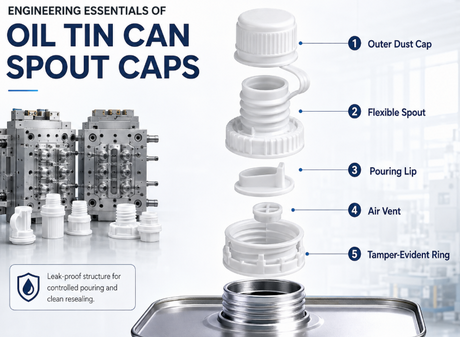
Consumer safety regulations across North America, Europe, and Asia mandate visible verification of closure integrity prior to purchase. Tamper-evident closure systems operate on the principle of plastic deformation and controlled fracture. The lower section of the screwed cap features a retaining ring attached to the main cap skirt via micro-bridges or a continuous thin web. As the cap is unthreaded from the spout fitment for the first time, internal retaining ratchets or a continuous folded flap engage an external retaining bead on the spout collar. Continued unscrewing force induces tensile stress in the micro-bridges until they fracture cleanly, detaching or dropping the ring down the spout shaft.
The engineering challenge lies in balancing bridge tensile strength against capping machinery line forces. If the micro-bridges are excessively thick, the torque required to break the tamper-evident ring exceeds consumer physical comfort, leading to end-user frustration or potential machinery jam during automatic capping. Conversely, if the bridges are structurally under-engineered, shock loads during bulk handling and high-acceleration capping operations cause premature fracturing, resulting in rejected inventory. Precision cutting or molded-in bridge geometries must be maintained within micron-level tolerances across all mold cavities to ensure consistent break forces.
In specialized segments such as pharmaceutical packaging or chemical delivery systems, child-resistant closure mechanisms are integrated alongside tamper evidence. These systems utilize double-skirt push-and-turn thread mechanics or squeeze-and-turn ratchet teeth. Deploying a specialized Spout Cap Mold designed with complex core side-action sliders enables the precise molding of these intricate internal locking features without inducing structural warping or thread distortion.
Feature Parameter | Standard Specification Range | Engineering Relevance |
|---|---|---|
Bridge Tensile Thickness | 0.15 mm to 0.35 mm | Dictates initial break torque and structural integrity during high-speed capping |
Retaining Flap Angle | 30° to 45° internal undercut | Ensures positive mechanical interlock against spout retaining ring during unscrewing |
Removal Torque Standard | 0.8 Nm to 1.8 Nm | Optimizes ergonomic manual opening force while preventing accidental breakage |
Ratchet Engagement Tooth Count | 6 to 12 perimeter points | Prevents non-destructive backing off or reverse rotation without breaking bands |
Selecting high-grade polyolefins with optimum Melt Flow Index (MFI), Environmental Stress Crack Resistance (ESCR), and mechanical rigidity is critical for long-term cap functionality.
High-Density Polyethylene (HDPE) and Polypropylene (PP) represent the dominant thermoplastics utilized in injection molding screwed spout caps. HDPE provides superior impact strength, flexibility at sub-zero temperatures, and excellent environmental stress crack resistance. This makes it the polymer of choice for packaging containing aggressive surfactant formulations, liquid detergents, or edible oils. Modern high-density polymers engineered specifically for caps feature narrow molecular weight distribution, minimizing orientation stress during the rapid cooling phase inside the mold cavity.
Polypropylene, including homopolymer and random copolymer variants, offers elevated flexural modulus, high surface hardness, and superior temperature resistance. PP caps are widely chosen for products undergoing hot-filling, retort sterilization, or microwave processing. However, PP exhibits lower impact strength at sub-zero conditions, which can lead to brittle fracture if dropped during frozen supply chain logistics. To mitigate this, block copolymers synthesized with ethylene content are specified for low-temperature application profiles, achieving a ideal balance between cap rigidity and impact toughness.
With increasing regulatory pressures toward circular economies, global buyers are increasingly integrating Post-Consumer Recycled (PCR) resins into cap production. Substituting prime virgin resin with PCR-HDPE or PCR-PP alters resin viscosity, shrinkage behavior, and structural consistency. Achieving consistent thread tolerances with PCR blends requires advanced cavity-pressure sensor technology and continuous melt temperature monitoring during the injection phase. Understanding the material behavior within a high-speed Spout Cap Mold guarantees that wall thickness and thread rigidity remain within critical quality control specifications despite batch-to-batch raw material variations.
Polymer Type | Density / MFI Range | Mechanical Strengths | Key Limitations |
|---|---|---|---|
HDPE (Injection Grade) | Density: 0.952-0.965 g/cm³ MFI: 2.0-8.0 g/10min | High ESCR, superb impact strength, excellent thread flexibility | Lower flexural modulus, susceptible to higher volumetric shrinkage |
PP Random Copolymer | Density: 0.900-0.910 g/cm³ MFI: 12-25 g/10min | High clarity, smooth surface finish, good thermal resistance | Moderate impact strength at sub-zero temperatures |
PP Block Copolymer | Density: 0.905-0.912 g/cm³ MFI: 8.0-20 g/10min | Exceptional impact toughness, high drop-resistance | Opaque finish, slightly lower clarity than random copolymers |
PCR-HDPE / Virgin Blends | Customized blend ratios (20%-50% PCR) | Reduced carbon footprint, regulatory compliance | Variable melt flow index, requires tight processing control |
Material Stress Crack Prevention Tip: When packaging products containing strong surfactants, citrus oils, or alcohol, ensure resin selection specifies an ESCR rating (ASTM D1693 Condition B) exceeding 1000 hours. Avoid excessive gate shear during molding to prevent built-in molecular orientation stresses that cause micro-fissuring along the thread roots.
Advanced multi-cavity tooling utilizing optimized core cooling, balanced runner systems, and high-precision unscrewing mechanisms forms the core of economic spout cap production.
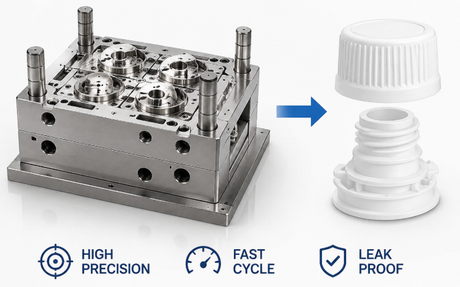
The commercial viability of mass-producing screwed spout caps depends directly on mold efficiency, cycle times, and dimensional repeatability. High-cavitation tooling configurations (ranging from 16 to 64 cavities) demand extreme thermal and hydraulic balance across every single impression. Cold runner systems are virtually obsolete in high-volume closure manufacturing due to material scrap costs and cycle time limitations. Modern tools employ fully insulated hot runner systems featuring individual valve gates or open tip nozzles. Valve-gate systems eliminate vestige protrusions on the cap crown, delivering a pristine visual surface and preventing interference with sealing mechanisms.
Unscrewing mechanisms are the defining engineering feature of screwed cap molds. Because thread profiles represent internal undercuts, caps cannot be ejected by straight mechanical pushing without stripping the threads. Molds utilize either internal rotating unscrewing cores driven by hydraulic motors, rack-and-pinion gear systems, or collapsing cores. Continuous thread closures typically require high-speed rack unscrewing systems synchronized with plate movement to rotate the core pin out of the cap interior before final ejection. Collapsing core technology eliminates rotation entirely by flexing inner segment cores inward, enabling straight forward ejection and reducing total mold cycle times by up to 30 percent.
Thermal management within core pins represents another critical engineering bottleneck. Polymer heat must be removed rapidly from the thick thread zones to prevent post-ejection thermal deformation. Utilizing high-thermal-conductivity copper-beryllium (CuBe) alloys or sintered metal 3D-printed conformal cooling channels within core pins ensures uniform heat extraction. Lowering cooling times from 8 seconds down to 3.5 seconds significantly enhances overall plant productivity, yielding millions of additional parts annually per production line.
Tooling System Component | Engineering Specification | Operational Impact |
|---|---|---|
Tool Steel Choice | S136, H13, or Stavax hardened to 52-56 HRC | Ensures long tool lifespan (exceeding 3 to 5 million shots) and corrosion resistance |
Ejection Architecture | Hydraulic Rack & Pinion / Collapsing Cores | Prevents thread stripping during high-speed continuous part stripping |
Hot Runner Manifold | Naturally balanced, individual nozzle temperature control | Guarantees identical cavity filling profiles and uniform part weights |
Cooling Channel Layout | Conformal cooling or CuBe core inserts | Accelerates cycle times and eliminates asymmetric shrinkage warpage |
Mold Maintenance and Core Alignment Protocol: Inspect unscrewing core bearings and gear racks every 250,000 cycles. Lubricate moving elements with high-temperature food-grade grease to prevent core misalignment, which causes uneven wall thickness and off-center thread engagement across cavities.
Systematic quality assurance protocols utilizing automated vision inspection, dynamic torque monitoring, and leak testing are essential to guarantee batch zero-defect requirements.
In high-speed beverage and chemical packaging lines, closure failures cause catastrophic production line downtime and expensive product recalls. Consequently, global buyers demand strict Statistical Process Control (SPC) metrics from cap suppliers. Critical quality attributes are evaluated using both destructive and non-destructive laboratory testing procedures. Immediate optical inspection systems mounted at the molding machine output utilize high-resolution cameras to verify 100% of caps for flash, short shots, incomplete tamper-evident bridges, and ovality before parts enter bulk packaging containers.
Application and removal torque testing measures the rotational energy required to seal and subsequently unseal the cap from a standardized spout fitment. Standardized testing protocols employ digital torque meters to establish torque curve profiles. Removal torque must fall within a calibrated band: high enough to resist accidental back-off caused by transit vibration, yet low enough to enable manual opening by consumers. Furthermore, strip torque testing measures the maximum rotational force a cap can endure before its internal threads deform or strip over the spout threads.
Leak resistance is verified through vacuum chamber testing and pressurized decay methods. Sealed spout cap assemblies are submerged in water inside an acrylic vacuum chamber; air pressure is reduced to simulate high-altitude air transport or thermal expansion during storage. Observation of escaping air bubbles identifies micro-pathways along the bore seal or thread profile. Drop impact testing evaluates full pouch or bottle assemblies dropped from heights up to 2.0 meters at both room temperature and frozen conditions (-18°C) to verify structural resistance against catastrophic rupture.
Quality Control Test | Testing Methodology Standard | Acceptance Threshold / Target |
|---|---|---|
Removal Torque Test | ASTM D2063 (Digital Torque Meter) | Within +/- 15% of engineering nominal rating (e.g., 1.2 Nm) |
Vacuum Leak Detection | ASTM D3078 (Bubble Emission in Vacuum) | No bubble leakage at -0.08 MPa for 60 seconds |
Micro-Bridge Tensile Break | Universal Testing Machine (UTM) axial pull | Bridge fracture occurring cleanly between 15 N and 35 N force |
Dimensional Ovality Audit | Coordinate Measuring Machine (CMM) / Optical Profilometer | Total radial deviation less than 0.08 mm across diameter |
Evaluating vendor technical capabilities, tooling quality, cavitation layout, and total cost of ownership allows global buyers to secure reliable spout cap supply chains.
When procuring screwed spout caps on an international scale, procurement managers must evaluate suppliers based on comprehensive engineering competence rather than unit piece price alone. Low-cost initial offers often conceal sub-standard mold design, uncalibrated hot runner systems, or inconsistent virgin-recycled polymer ratios. These deficiency leads to high scrap rates on automated capping lines, thread failure, and variable sealing performance during distribution.
A rigorous vendor evaluation process begins with a detailed audit of the mold manufacturing facility and injection processing capabilities. Key indicators of manufacturing excellence include the use of high-tier European or Asian CNC machinery, electric or hybrid injection molding machines capable of precise shot repeatability, cleanroom manufacturing environments for food/medical grade caps, and ISO 9001 / FSSC 22000 certifications. Buyers should request cavity balance reports, cycle time demonstrations, and multi-cavity CMM dimensional audits prior to authorizing tool sign-off.
Cost optimization is best achieved through cavitation scaling and component standardization. Transitioning from a 16-cavity tool to a 32- or 48-cavity tool significantly reduces unit production costs, offsetting capital expenditure when production volumes exceed tens of millions of units annually. Furthermore, standardizing neck finish dimensions (such as 8.5mm, 10mm, 15mm, or 22mm spout diameters) across product lines enables buyers to utilize standardized capping machinery, reducing changeover downtime and inventory complexity across global manufacturing sites.
Evaluation Category | Key Technical Metric | Strategic Buyer Objective |
|---|---|---|
Tooling Engineering | Core cooling efficiency, rack unscrewing speed | Maximize shot speeds and lower unit production costs |
Process Consistency | CPK index on critical thread dimensions (> 1.67) | Ensure zero-defect performance on high-speed filling lines |
Quality System Compliance | ISO 22000, FDA/EU food contact approval | Mitigate regulatory risk for edible or pharmaceutical packaging |
Supply Chain Risk Management | Multi-cavity redundancy, raw material safety stocks | Prevent stock-outs and buffer against global shipping disruptions |
Screwed spout caps represent a critical structural interface in modern flexible and rigid liquid packaging. Delivering consistent performance requires a holistic engineering approach encompassing thread mechanics, linerless bore sealing dynamics, controlled tamper-evident fracturing, precise polyolefin selection, and high-efficiency multi-cavity mold architecture. By deploying advanced unscrewing tooling systems, rigorous quality testing protocols, and robust vendor auditing standards, global packaging buyers can secure high-performing, leak-proof, and cost-effective screwed spout cap solutions tailored to the rigorous demands of global supply chains.