Views: 0 Author: Site Editor Publish Time: 2026-08-05 Origin: Site


The packaging industry is experiencing a massive structural shift. Rigid plastic bottles are rapidly giving way to flexible pouches. Consumers demand lightweight, sustainable alternatives. This evolution directly impacts downstream manufacturing tooling. Transitioning your product lines requires substantial capital expenditure in injection molding.
Plant managers face a critical crossroad. Choosing between standard bottle cap molds and specialized spout cap molds dictates everything. It controls your cycle times. It determines your part quality. It ultimately defines your ongoing maintenance overhead. Making the wrong tooling choice leads to severe production bottlenecks.
This article provides a transparent, engineering-focused breakdown of these two systems. We will explore their structural differences and primary cost implications. You will learn the strict selection criteria needed to finalize your tooling investments. Our goal is to help your procurement and production teams navigate this complex transition confidently.
Structural Complexity: Spout caps require specialized geometries (e.g., weld-ready bases) that demand advanced unscrewing mechanisms and complex slider designs compared to standard bottle caps.
Production Speeds: Standard bottle cap molds often utilize compression molding or highly simplified injection systems for maximum speed, whereas spout caps require highly optimized cooling channels to prevent deformation.
Capital Investment: The specialized nature of a Spout Cap Mold for Spouted Pouches typically results in higher upfront tooling costs but opens access to the high-margin flexible packaging market.
Maintenance Realities: Spout cap molds possess intricate moving parts that require stricter preventive maintenance schedules to avoid flash and ensure perfect sealing capabilities.
The fundamental design of a mold dictates its operational behavior. Standard bottle caps prioritize sheer volume and simplicity. They feature uniform threading. Their designs usually include simple tamper-evident rings. The geometry allows for rapid cooling and straightforward ejection. Engineers design these molds for relentless, high-speed repetition.
Spout caps present a vastly different geometric challenge. They feature internal threading. They also possess secondary base components. These bases are specifically designed for heat-sealing directly to flexible film. The exterior often includes protective ribs. These ribs prevent damage during the pouch-filling process. This complex geometry requires specialized mold features.
Ejection and demolding mechanisms highlight the biggest engineering divide. Rigid bottle cap molds rely heavily on standard stripper plates. The machine opens, and the plate simply forces the plastic off the core. It is a violent, highly efficient mechanical action. It requires minimal moving parts within the mold itself.
Spout caps cannot survive forced stripping. The internal threads and sealing flanges would tear. Therefore, spout molds require complex unscrewing mechanisms. Tooling engineers integrate hydraulic racks or servo-motor systems. These mechanisms rotate the cores precisely before ejection. This preserves thread integrity completely. It ensures the sealing surfaces remain untouched and pristine.
Cavity layouts also look very different. Cavitation density drives your total yield per cycle. Standard bottle caps have a very narrow footprint. Toolmakers can pack 96 or even 128 cavities into a single mold base. Spout caps feature wide, weld-ready bases. This wider flange consumes more physical space on the mold plate. Consequently, a spout mold footprint limits the total number of cavities. You might only fit 48 or 64 cavities in the same machine space.
Tooling Architecture Comparison
Feature | Standard Bottle Cap Mold | Spout Cap Mold |
|---|---|---|
Core Geometry | Uniform threading, simple profile | Internal threading, wide heat-seal base |
Demolding Mechanism | Forceful stripper plate | Hydraulic or servo-driven unscrewing |
Cavitation Density | Extremely high (up to 128 cavities) | Moderate (often limited by flange width) |
Tamper-Evident Design | Simple breakaway ring | Complex integrated sliders required |
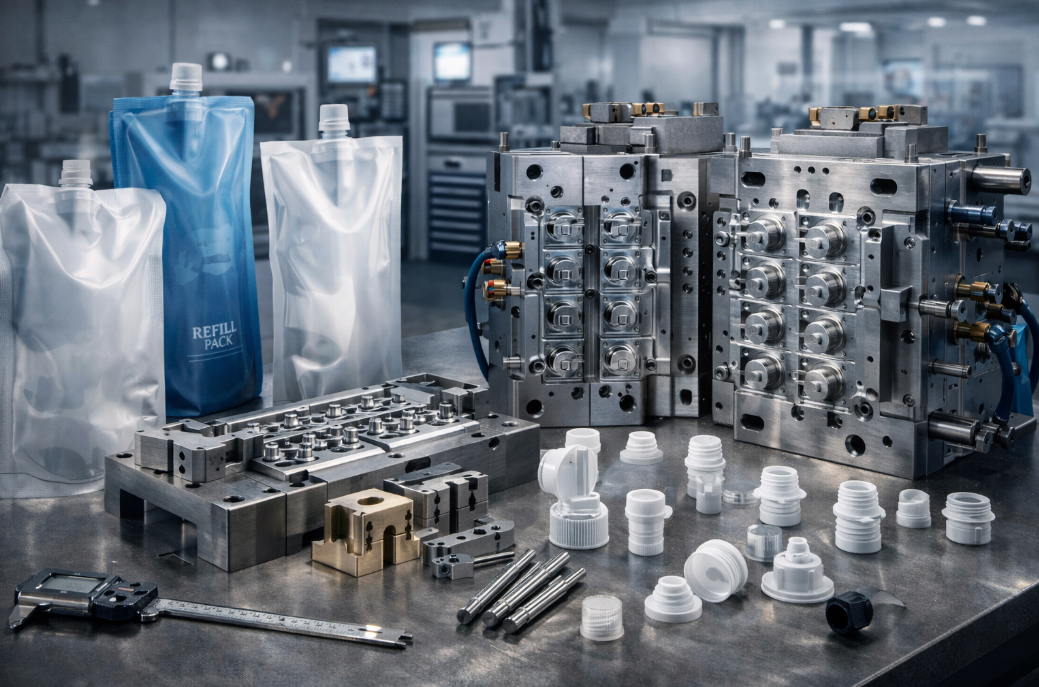
Designing a high-performance Spout Cap Mold for Spouted Pouches requires exceptional precision. You cannot treat it like a standard closure. The integration with flexible packaging introduces severe tolerances. Every feature must support the final pouch-filling and sealing operations.
The weld base presents the ultimate engineering challenge. The base of the spout fuses directly to the pouch film. This area must be molded with zero flash. It requires perfect concentricity. Any microscopic defect here leads to a failed heat-seal. A failed seal results in subsequent product leakage. This leakage destroys brand reputation and causes massive product recalls.
Tamper-evident integration further complicates the mold design. Consumers must see a clean break upon first use. Molding these integrated bands requires precise slider alignments. The mold cores must retract flawlessly. If the sliders hesitate, the tamper-evident bridges stretch. Stretched bridges ruin the consumer experience. Toolmakers must machine these slider pockets to exact micron tolerances.
Resin flow and gate placement require advanced simulation. Spout caps feature variable wall thicknesses. The threaded sections are relatively thin. The sealing bases are much thicker. This discrepancy causes uneven material distribution. Precision hot runner systems become an absolute necessity. Valve gates control the plastic injection precisely.
Proper gate placement prevents structural warpage. If you place the gate incorrectly, the base will warp. A warped base cannot seal to a flat pouch. Engineers rely heavily on mold flow analysis here. They simulate the resin fill to balance the cavity pressure. This ensures the thin walls pack out perfectly before the thick sections freeze.
Cooling dictates your ultimate production efficiency. It is always the primary bottleneck in injection molding. Plastic retains heat stubbornly. You must extract this heat before the part can eject safely. Standard caps utilize straightforward straight-line cooling channels. They achieve rapid heat transfer easily.
Spout caps demand highly advanced cooling systems. The complex cores trap heat deep inside the mold. Standard drilled channels cannot reach these hot spots. Therefore, engineers deploy conformal cooling. Conformal cooling channels hug the exact contours of the core pins. They snake around the internal threads. This specialized cooling prevents part shrinkage.
Cycle time expectations differ significantly between the two systems. You must set realistic, evidence-based assumptions. Simple bottle caps achieve incredibly fast speeds. Standard injection or compression molding can hit sub-5-second cycles. The simplified geometry allows aggressive cooling and violent ejection.
Multi-feature spout caps require slightly longer cycles. A typical cycle might range from 8 to 12 seconds. The plastic must solidify completely around the unscrewing cores. If you eject too early, the threads will strip. The weld base will warp. You must prioritize structural stability over raw speed.
Risk mitigation requires proactive engineering choices. High-speed unscrewing mechanisms introduce intense friction. This friction causes common production risks. You must actively manage these threats to maintain efficiency.
Thread Galling: Friction between the rotating core and the plastic causes surface tearing. High-grade lubrication and polished cores prevent this.
Uneven Cooling: Hot spots cause the base flange to warp. Conformal cooling lines eliminate these thermal inconsistencies.
Thermal Fatigue: Millions of heating and cooling cycles crack cheap steel. Utilizing premium mold steel mitigates this risk entirely.
Choosing the right mold steel is non-negotiable. Toolmakers must use high-grade alloys like S136 or H13. These hardened steels resist thermal fatigue. They maintain their dimensional stability over millions of cycles. Soft steel will inevitably warp. Warped steel creates flash, ruining your production run.
Procuring advanced packaging tooling requires a strategic financial approach. Upfront cost variances are immediately apparent when comparing these two mold types. Standard bottle cap molds benefit from simplified engineering. They require standard stripper plates and basic hot runners. This keeps the initial purchase price relatively low.
Spout cap molds inherently carry a substantial premium. The upfront costs reflect the advanced engineering required. You are paying for integrated servo-unscrewing motors. You are investing in highly complex hot runner valve gates. The machining tolerances are significantly tighter. Toolmakers spend hundreds of extra hours polishing the sealing flanges.
Maintenance realities directly dictate the lifespan of your investment. Standard cap molds are rugged. They survive aggressive running with basic wipe-downs. Spout cap molds demand meticulous, scheduled care. They possess intricate moving parts. Sliders, racks, and unscrewing gears operate under immense pressure.
Technicians must execute strict preventive maintenance routines. They must clean and lubricate the moving core components frequently. Failure to lubricate leads to immediate galling. The gears will seize. Production will halt. You must factor this maintenance downtime into your production schedule.
Cheaper tooling always leads to premature failure. Some buyers attempt to save money using softer steel choices. This is a critical mistake. Soft steel wears down quickly at the parting lines. This wear creates plastic flash. Flash on a spout cap ruins the spout-to-pouch seal. Once a mold begins flashing, it requires expensive welding and remachining. Investing in hardened stainless steel upfront guarantees long-term reliability.
Selecting the right tooling requires a holistic evaluation of your facility. You cannot make this decision based on mold price alone. You must analyze your specific production environment. Cross-functional teams must evaluate several strict criteria.
Volume and Scale Requirements: Analyze your target market. Are you producing billions of standard water bottles for commodity markets? Standard high-cavitation molds fit perfectly here. Are you entering the premium flexible pouch market? You will need the specialized architecture of a spout mold to compete.
Machine Compatibility: Inspect your current injection molding machinery. Complex spout molds demand specific tie-bar spacing. They require integrated servo controls or hydraulic core pull interfaces. Your older machines might not support these advanced unscrewing mechanisms. Upgrading your machines adds to the project scope.
Compliance and Quality Control: Evaluate your industry regulations. Food, beverage, and cosmetic applications enforce stringent leak-testing requirements. Spouted pouches undergo aggressive squeeze tests. Your mold must produce perfect, repeatable sealing flanges to pass these compliance checks.
Shortlisting vendors requires rigorous vetting. You must ask mold makers specific, challenging questions. Do not accept generic promises. Request actual case studies on their conformal cooling performance. Demand to see their mold flow analysis data for similar geometries. Verify their steel sourcing certificates. Ensure they possess deep experience specifically with flexible packaging integration.
The packaging industry's transition demands strategic tooling investments. Standard bottle cap molds clearly lean toward high-speed, high-volume simplicity. They are rugged and highly efficient. Conversely, spout cap molds are highly complex, precision-engineered assets. They are specifically designed for the strict demands of flexible packaging integration. They require careful maintenance and premium materials.
Your next steps should focus on technical validation. Encourage your engineering team to request a comprehensive tooling audit. Commission a professional mold flow analysis for your specific part design. Validate the cooling dynamics and unscrewing mechanisms before committing to a mold builder. Taking these calculated steps ensures your production line remains profitable, efficient, and leak-free.
A: It depends heavily on the machine's specifications. Spout cap molds require specific tie-bar spacing to accommodate wider mold bases. More importantly, your machine needs integrated servo or hydraulic core pull controls. These interfaces power the complex unscrewing mechanisms. Without them, you cannot demold the threaded caps safely.
A: The industry standard ranges from 3 to 5 million cycles, and often higher. However, this lifespan is entirely contingent on two factors. First, the mold must use hardened premium steel like Stavax or S136. Second, your facility must adhere to strict, scheduled preventive maintenance and lubrication routines.
A: Minor flash on a rigid bottle cap is usually just a cosmetic defect. It rarely impacts the bottle seal. However, flash on the weld base of a spout prevents a hermetic seal with the pouch film. This defect leads to immediate product spoilage and leakage during shipping.