Eliminating Downtime: A Strategic Guide to Precision Mold Components for High-Cycle Medical & Packaging Tools
In high-volume molding, unplanned downtime rarely starts with a dramatic failure. It usually begins with a small mismatch in fit, a drifting shut-off, or a wear pattern that gradually turns stable production into repeated adjustment. For buyers working on medical and packaging tools, precision mold components are not just spare parts. They are the mechanical foundation of yield, uptime, and mold life.
This is especially true in projects that run with high cavitation, tight cosmetic standards, or demanding ejection conditions. In both medical mold components and packaging tooling, the real question is not whether a part can be machined, but whether it can stay stable under repeated thermal and mechanical cycling.
I. Why Component Precision Dictates the Ceiling of Your Injection Project
In high-output plastic injection molding, the performance ceiling of the entire project is determined by the consistency of the mold’s critical fit chain. When tolerances drift at the component level, the mold may still run, but it no longer runs predictably.
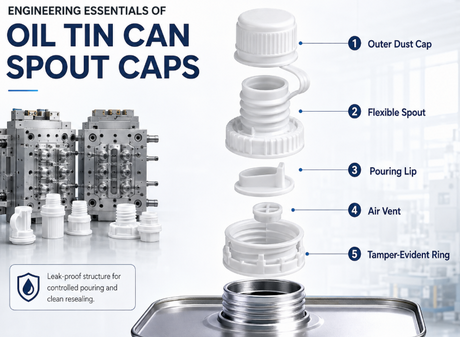
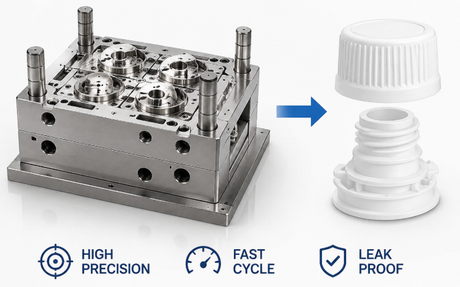
In beverage closures and cap tooling, poor fit often shows up as flash, burrs, leakage risk, and unstable thread engagement. That is why buyers involved in caps mold components usually focus on shut-off integrity, interchangeability, and wear stability long before they focus on appearance.
- Flash and burrs: often caused by unstable sealing areas and inconsistent parting line fit.
- Dimensional drift: typically linked to steel behavior, heat treatment control, and process instability during continuous production.
- Frequent seizing: commonly related to friction, poor sleeve fit, or inadequate surface treatment in high-cycle tools.
The most expensive component is often the one that looked inexpensive at purchase but later caused downtime, fitting work, scrap, and repeated maintenance.
II. Core Component Selection: Solving Industry-Specific Pain Points
1. Cavity & Core Inserts: The Foundation of Surface Quality and Dimensional Accuracy
For packaging and cosmetic applications, cavity and core insert quality directly affects both appearance and repeatability. In many projects, the insert is not just forming the part. It is controlling sealing behavior, thread quality, release performance, and long-term wear.
For projects that require stable geometry retention and controlled surface finish, well-machined custom precision cavity inserts for packaging molds can reduce later polishing variation and help keep part dimensions consistent from cavity to cavity.
2. Ejection Systems: The Invisible Driver Behind Scrap and Stability
In medical tools such as pipette tip molds or reaction cup molds, even minor deviation in sleeves, ejector guidance, or concentricity can create stress whitening, drag marks, or inconsistent release. These issues are easy to underestimate because they may not appear during bench inspection, but become obvious during high-speed production.
Surface engineering matters here. Hardened sleeves, proper coating selection, and verified concentricity reduce friction and help maintain smoother, more balanced ejection. From a process-control standpoint, this is where machining discipline and inspection capability matter more than generic “high precision” claims. The logic behind that can be seen in SENLAN’s technical advantages, where machining stability, CMM inspection, and process control are treated as part of the production system rather than as isolated selling points.
3. Alignment & Guiding: Locking in Repeatability Across Cavities
Multi-cavity molds depend on alignment every time the mold closes. If the guiding system wears unevenly or the fit chain is inconsistent, the result is not only wear, but also unstable sealing, mismatch, and growing variation across cavities.
This is why buyers sourcing side locks, locating elements, and guided fits should pay close attention to how the supplier manages ±0.005 mm tolerance control in precision mold components. Controlled tolerances help convert alignment from an assumption into a repeatable result.
III. Material & Heat Treatment: Beyond Standard Steel
A precision component’s service life is rarely determined by hardness alone. Long-run stability depends on the balance between toughness, hardness, corrosion resistance, and the suitability of the material for the resin and molding environment.
For beverage and high-volume closure projects, especially where repeat output and wear stability matter, it is often necessary to evaluate whether the component belongs in general packaging tooling or more specialized platforms such as PET preform mold parts, where the expectation for cavity consistency and production continuity is especially high.
For medical applications or humid production environments, corrosion resistance becomes part of dimensional control. In these cases, material strategies built around hardened stainless steels are often more reliable than lower-grade alternatives. One relevant example is high corrosion resistant medical injection mold parts in 420 stainless steel, where material choice supports both cleanliness and long-term surface stability.
IV. The Direct Factory Edge: Why Hardware Proof Matters
Buyers often hear similar promises from many suppliers: high precision, stable quality, fast delivery. What separates a dependable supplier from a risky one is whether those claims are supported by a machining route, inspection logic, and equipment capability that match the actual geometry of the part.
In real production, repeatability comes from process selection, not from wording. A useful example is how precision mold components are stabilized for multi-cavity molds: by selecting machining routes based on CTQ features, feature accessibility, and material condition, rather than applying the same process to every part.
That approach is easier to maintain when the supplier is a direct manufacturer with in-house control over machining, inspection, and correction loops. As shown on SENLAN’s company profile, the value of a direct factory model is not simply lower markup. It is the ability to connect drawings, process planning, inspection, and final fit into one controlled workflow.
V. Troubleshooting: Common Failure Modes and Optimization Directions
| Issue | Root Cause at Component Level | Optimization Direction |
|---|---|---|
| Flash / Burrs | Alignment wear, unstable shut-off fit, poor repeatability | Upgrade guiding components, refine fit tolerances, improve dimensional consistency |
| Part Drag / Surface Scratches | Poor surface finish, inadequate release behavior, local mismatch | Improve EDM/polishing route and verify geometry retention |
| Ejector Pin Marks | Imbalanced ejection force, sleeve friction, guidance error | Review sleeve fit, coating strategy, and concentricity control |
| Ovality in Caps | Uneven support, thermal distortion, unstable plate or insert fit | Optimize cooling logic and improve insert interface stability |
These problems are easier to solve when the supplier can trace them back to component-level causes instead of only adjusting molding parameters. A practical reference is this 24-cavity bottle cap mold case study, which shows how dimensional variation in critical mold parts can directly affect sealing stability, downtime, and production consistency.
VI. Conclusion: Turning Uncertainty into Controlled Performance
Precision mold components and custom tooling do not create value by making a mold “more expensive.” They create value by making production more predictable. When the critical dimension chain is stable, the mold runs longer, scrap drops, fitting work decreases, and output becomes easier to control.
For medical, cosmetic, and packaging projects, the supplier selection logic should go beyond price and lead time. It should focus on whether the supplier can understand the part’s CTQ features, choose the right material and machining route, and support the mold with a consistent engineering process. That is where custom mold parts and tooling solutions become more than a quotation category. They become part of risk control.
Ready to Audit Your Component Strategy?
If you are dealing with unstable dimensions, repeated fitting work, or frequent mold maintenance, now is the time to review the component strategy behind the tool. A drawing review at the component level can often identify the real source of downtime before it becomes a larger production problem.
Request a factory-direct quote or submit your drawing for technical review.