Maximizing Injection Molding Machine Performance: Why Precision Components Are the Silent ROI Driver
When manufacturers evaluate a molding line, the discussion usually starts with the machine: repeatability, clamping force, servo response, energy efficiency, and cycle speed. These are valid questions. Choosing the right plastic injection molding platform is especially important in packaging and medical production, where output stability directly affects profitability.
But in real production, machine performance is only part of the equation. You can invest in a premium all-electric press and still face flash, unstable dimensions, scrap, and downtime if the precision mold components inside the tool are not built to the same standard. A cavity insert or ejector sleeve with a deviation of ±0.02 mm may still appear acceptable on a drawing, but under high-speed cycling, that micro-gap becomes a measurable production cost.
The real brain of the molding cycle is not only the machine itself. It is the precision of the mold system that controls sealing, alignment, cooling, release, and cavity-to-cavity consistency. In high-cycle manufacturing, precision is not a premium detail. It is part of operational security.
Injection Molding Machines Matter, but They Cannot Compensate for Weak Tooling
Injection molding machines generally fall into three categories: hydraulic, all-electric, and hybrid. Hydraulic machines remain widely used for their strength and durability. All-electric presses are often preferred for cleanroom, medical, and precision applications where repeatability and control are critical. Hybrid machines offer a balance between power and efficiency.
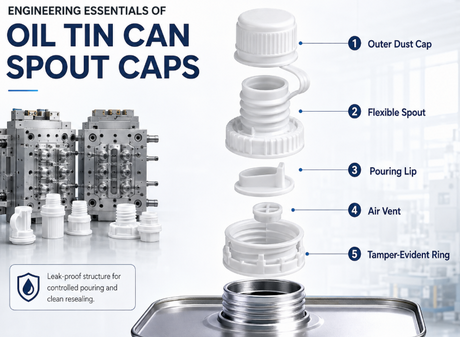
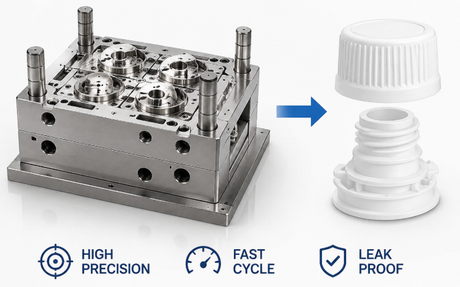
Even so, the most advanced servo-driven system cannot fully compensate for poor thermal balance, inconsistent mold closure, or weak shut-off stability. In high-output closure production, especially where buyers rely on durable caps mold components, the limiting factor is often not the machine specification, but the consistency of the tool under repeated production load.
The Micro-Gap Theory: Where Scrap Really Begins
Most production losses do not begin with a major machine alarm. They begin with micro-gaps: a slight mismatch in insert seating, a small deviation in sleeve concentricity, or a subtle alignment shift during mold closure. These issues may look minor during inspection, but under repeated cycles they become the root cause of flash, drag marks, burrs, ovality, uneven wear, and unstable demolding.
This is why mold component quality must be judged by functional performance, not by nominal dimensions alone. The deeper question is whether the supplier has the manufacturing route, measurement discipline, and process control to build those dimensions repeatedly. That is also why buyers comparing suppliers should look closely at their CNC machining capabilities for precision mold parts, especially for fit-critical interfaces and high-wear areas.
How Precision Components Reduce Wear on Your Injection Molding Machine
A high-end injection molding machine is designed for controlled motion. But when the mold system is unstable, that motion becomes mechanical stress. If inserts do not seat consistently, if sleeves drag during ejection, or if shut-offs wear unevenly, the machine is repeatedly forced through imperfect cycles. Over time, this contributes to more correction, lower process stability, and more hidden loss in uptime.
Precision components help reduce that burden in several ways:
- Stable sealing supports more predictable closure and lowers the need for corrective compensation.
- Better alignment helps distribute load more evenly and reduces localized wear.
- Balanced ejection lowers friction-related stress and helps keep release behavior consistent.
- Improved seating accuracy supports more stable heat transfer and a narrower processing window.
At this level, precision is not only about the part. It is about helping the entire molding system operate closer to its intended performance range.
Interchangeability Means Less Time in Maintenance and More Time in Production
One of the clearest differences between average tooling supply and serious precision manufacturing is interchangeability. In many factories, replacement parts technically match the drawing but still require spotting, polishing, or fitting before they can return to production. That extra bench work consumes maintenance hours and increases restart risk.
True interchangeability means a replacement component can be installed with minimal correction. This reduces maintenance time and keeps the machine producing instead of waiting. For high-cycle molds, that is not simply a convenience. It is a direct ROI issue.
Surface Integrity Is Not Cosmetic. It Is Mechanical Efficiency.
Surface finish is often discussed only in terms of product appearance. At mold component level, however, surface integrity also affects friction, release behavior, wear, and process stability. A controlled EDM surface can do more than improve the molded part visually. It can reduce release resistance and lower the need for excessive manual correction that may damage geometry.
This is where manufacturing discipline becomes visible. On SENLAN’s technical advantages page, the logic is clear: premium materials, controlled heat treatment, Zeiss measurement, and ±0.005 mm tolerance capability are treated as process requirements, not as marketing decoration.
The Hardware Proof Behind Precision Manufacturing
Precision claims are easy to write. Hardware proof is harder to fake. For engineering buyers, the real question is whether the supplier’s equipment and inspection route actually match the CTQ features of the part.
Powered by:
MAKINO V33i — supports stable high-speed machining of precision mold features.
SODICK EDM — supports fine details, geometry retention, and critical molding surfaces.
ZEISS CMM — supports dimensional verification for fit-critical features.
Buyers who want evidence behind those claims can review SENLAN’s equipment overview, which helps show that the business is operating as a direct manufacturing source rather than simply reselling parts.
Standard Tolerance vs Precision Tolerance: What It Means for Machine Output
| Comparison Item | Standard Component Control | SENLAN Precision Control |
|---|---|---|
| Typical tolerance capability | ±0.02 mm | ±0.005 mm |
| Replacement part fit | Often requires fitting and manual correction | Supports reduced fitting and faster service return |
| Machine uptime | More stoppages caused by instability and adjustment | Better support for predictable runtime |
| Scrap risk | Higher risk of flash, mismatch, and drag | Lower risk through tighter fit control |
| OEE impact | Hidden losses accumulate over time | Improved support for availability, performance, and quality |
Why Direct Manufacturing Control Matters
Buyers often hear similar claims from many suppliers: high precision, stable quality, fast response. The real difference is whether the supplier can connect drawings, machining, inspection, and final fit into one controlled workflow. That is the real value behind a direct source manufacturing model, and it is also part of what SENLAN explains on its company profile page.
Quick Links by Application
High-Speed Packaging: Optimizing your 48-cavity cap mold for faster and more stable production? View our precision cavity inserts.
Medical Cleanroom Tooling: Need flash-free medical tooling support with micron-level control? Explore our medical mold components.
Custom Engineering Support: Looking for a route from drawing review to production-ready mold parts? Review our custom tooling solutions.
Conclusion: Do Not Let Weak Components Set the Limit of Your Machine
A premium injection molding machine should not be judged only by its specification sheet. Its true value is measured by uptime, scrap rate, maintenance frequency, cavity consistency, and how reliably it holds the process window in daily production.
That performance is shaped every day by the mold components inside the tool. If cavity inserts, ejector sleeves, guiding elements, and fit-critical interfaces are not manufactured to the precision the application demands, even the best machine will operate below its potential. Precision components are the silent ROI driver because they improve not only the part, but the production conditions under which the whole system runs.
Related Reading
Do Not Let Low-Quality Components Limit Your Injection Molding Machine
Send your drawings to SENLAN for a technical DFM review and see how micron-level precision can translate into more stable production, lower scrap, and stronger factory profitability.
Apply for a Technical Consultation | Download Our Precision Mold Component Quality Report